

Hisense 65E6QF Review: The Brutally Honest Truth About a $378 65″ TV
| Feature | Spec | What It Means for You |
|---|---|---|
| Display Technology | QLED, Full Array LED backlight | Better contrast and color than edge-lit budget TVs |
| Resolution | 4K (3840 x 2160) | Standard for this size in 2026 |
| HDR Support | Dolby Vision, HDR10+, HDR10, HLG | Broad compatibility with streaming HDR content |
| Refresh Rate | 60Hz native, HDMI VRR supported | Smooth for movies and streaming; VRR helps reduce screen tearing in supported games |
| HDMI | 3 ports, HDMI 2.1 | Enough for a console, a streaming box, and a soundbar |
| Bluetooth | 5.2 with BLE | Pairs headphones and controllers reliably |
| Audio Out | Optical (SPDIF), no ARC | Soundbar connection works, but plan on optical, not HDMI passthrough |
The 60Hz native refresh rate is the one spec that scares people off, and it’s mostly not worth the worry. If you’re chasing 144Hz+ competitive gaming, this was never going to be your TV regardless of price. For everyone else — movies, streaming, casual and even semi-serious console gaming — 60Hz with VRR support handles motion just fine.
VIZIO OS: The Boring Stuff, Done Right
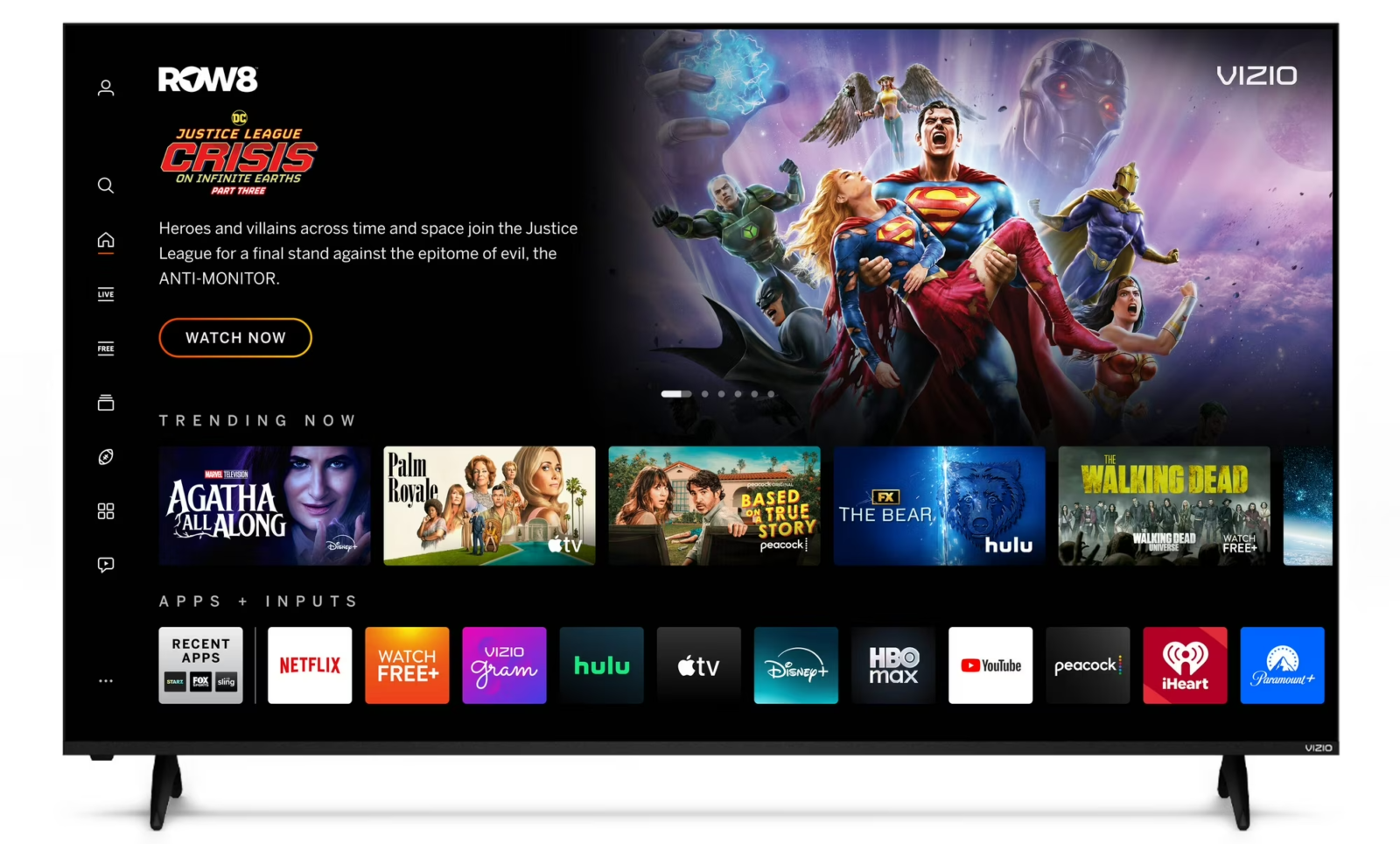
The best compliment you can pay a smart TV platform is that you stop thinking about it. VIZIO OS mostly earns that. It comes with Netflix, Disney+, Max, Apple TV, Prime Video, Paramount+, and Spotify already installed, so you’re not hunting through an app store on day one. It updates itself over WiFi in the background — no manual firmware downloads, no version-lock frustration a year in. And WatchFree+, VIZIO’s ad-supported free tier, has a genuinely large library if you’re the type who just wants something on.
It’s not going to out-app Roku’s ecosystem, and the interface won’t wow anyone. But it doesn’t need to. It gets out of your way, which for a lot of people is the entire point.

Last updated on 2026-09-16
Connectivity That Actually Matters in a Real Home
WiFi 6 on a sub-$400 TV sounds like overkill until you remember most homes now have a dozen devices fighting over the same 2.4GHz band. Better performance in a congested network is a real, if unglamorous, upgrade. Add AirPlay 2 and Google Cast for quick phone-to-TV streaming, plus Apple Home, Google Home, and Alexa integration for anyone building out a smart home setup, and the connectivity here is more capable than the price suggests.
One caveat worth knowing before you buy: there’s no ARC or eARC on this TV. If you’re planning to run a soundbar through it and want Dolby Atmos passthrough, you’ll be relying on the optical output, which has real limitations — it won’t carry the same object-based Atmos signal that eARC does. If Atmos audio matters a lot to your setup, this is worth checking against your soundbar’s own inputs before you commit.
Gaming: What It Can and Can’t Do
At 1080p, this TV supports up to 120fps, which covers a lot more ground than it sounds like — most consoles aren’t pushing true 4K/120 over HDMI 2.0 bandwidth anyway, so a lot of “4K gaming” already happens at 1080p or 1440p compromises behind the scenes. At native 4K, you’re capped at 60fps, and HDMI VRR helps smooth out frame pacing in games that support it. A dedicated gaming mode kicks in automatically to cut input lag, and the TV powers on instantly when it detects a connected controller — a small touch, but one you’ll notice.
If you’re a competitive shooter player chasing 240Hz, this was never in your price range to begin with. For console gaming, story-driven titles, or casual PC gaming, it’s more than capable.
What People Actually Notice After Buying It
Customer feedback lines up with the spec sheet: bright, sharp images; decent built-in sound for a TV in this class (though nothing that replaces a real soundbar); and a remote and app interface that reviewers consistently rate above comparable Samsung budget models. The most common complaint is bulk — it’s a 65-inch TV, so it’s not going anywhere quietly, and it’ll need a proper stand or wall mount rated for its weight.
How It Stacks Up on Price
| TV | Approximate Price | |
|---|---|---|
| VIZIO VQD65M-08 (65″) | $378 | SEE PRICE |
| Samsung U8000 70″ | $500–600 | SEE PRICE |
| Samsung Q80D 75″ | $1,200–1,400 | SEE PRICE |
| Sony K95XR 65″ (mini-LED) | ~$3,000 | SEE PRICE |
| LG OLED65G5WUA | ~$2,500 | SEE PRICE |
You’re not getting flagship contrast or panel-level black levels here. What you are getting is most of the smart-platform and color-quality experience of TVs costing three to eight times as much.


Last updated on 2026-09-16
Frequently Asked Questions
Can this TV do 4K/120fps gaming?
No. It’s a native 60Hz panel, so 4K tops out at 60fps. The 120fps mode is specifically a 1080p feature. If you need 4K/120, you’re looking at a $1,000+ TV.
Does VIZIO OS have the apps I actually use?
It ships with Netflix, Disney+, Max, Apple TV, Prime Video, Paramount+, and Spotify pre-installed, with more available through the app store. It’s not as deep as Roku’s catalog, but it covers the apps most people actually use daily.
Can I connect a soundbar and get Dolby Atmos?
You can connect a soundbar, but this TV doesn’t have ARC or eARC, so full HDMI-based Atmos passthrough isn’t supported the way it would be on a TV with eARC. Your best option is the optical audio output, which works but has its own limitations — check compatibility with your specific soundbar before assuming full Atmos support.
Does WiFi 6 matter if my router isn’t WiFi 6?
Not really — you’ll get backward compatibility with WiFi 5/4, but none of the bandwidth benefit. If your router is WiFi 6, you’ll notice better performance in a busy household.
Will it keep getting updates?
Yes — VIZIO OS updates automatically over WiFi, so you’re not stuck on outdated firmware the way older TV platforms could leave you.
Is it good for a gaming PC?
Yes, as a secondary or casual display. You’ll get 1080p/120fps or 4K/60fps depending on what you’re running. It’s not built for competitive esports at high resolution, but it’s a fine everyday gaming monitor.
How’s the remote?
Included, voice-enabled, and a real step up from older VIZIO remotes. Buttons are responsive and voice search works reliably. The mobile app is a solid backup if you lose it.
| Preview | Product | Rating | |
|---|---|---|---|
 | XRT140 Replace Remote Control fit for Vizio Smart TV HDTV V Series V705-H3* | CHECK PRICE |
Last updated on 2026-09-16
Is it really 65 inches?
Yes — 64.5″ diagonal viewable, which is standard for the “65-inch class” naming convention. A 75″ version is also available.
Can it be wall-mounted?
Yes, standard VESA mounting is supported. Given the size and weight, professional installation is worth the cost.