We do the homework so you can make your home work.™

How to Find the Perfect Kitchen Scale for Your Needs

Nerdy Home Tech uses affiliate links. These links will help support the site. For more information, visit our Disclosure page.

Measuring Cups vs. Kitchen Scales: Why (and When) to Make the Switch

You’re following the recipe exactly. Same flour, same sugar, same everything. But last time your cookies spread flat. This time they’re too dense. Two runs, two failures, and you have no idea what changed.

The problem isn’t your technique. It’s probably your measuring cups.

The Real Problem With Volume Measurement

Here’s the uncomfortable truth: a cup of flour isn’t always the same weight. It depends on how you pack it, how you scoop it, the humidity that day, and whether you leveled it off. A single cup of all-purpose flour can range from 110 grams to 130 grams—that’s an 18% swing.

For some baking, that slack doesn’t matter. For others, it’s catastrophic.

Dry ingredients are measured by volume in most home recipes because it’s convenient. You grab a cup, fill it, move on. But convenient isn’t consistent. Weight—measured in grams—is. A scale doesn’t care about packing technique or weather. 100 grams is 100 grams.

The question isn’t whether you should switch to a scale. The question is what you’re actually baking, and whether inconsistent results are costing you time or frustration.

Every time you switch back to measuring cups after using a scale, you reintroduce variance. Once you’ve baked with a scale for a month, going back feels like a step backward.

Where Precision Actually Matters (And Where It Doesn’t)

Let’s be hones-not every recipe needs a scale. The decision depends entirely on what you’re making.

Bread (both yeast and quick bread):

Precision matters here. The ratio of flour to water determines hydration, which drives gluten development, crumb structure, and rise. A 5% swing in flour weight—about 8 grams in a standard loaf—can be the difference between an open, airy crumb and a dense, gummy one.

A scale is practically mandatory if you’re trying to dial in artisan breads or sourdough. Even quick breads like banana bread or scones respond noticeably to flour consistency.

Cakes:

Moderate precision needed. A standard cake recipe can tolerate about a 10% variance in flour before the texture becomes noticeably off. You’ll see drying, sinking centers, or overmixing problems.

That said, if you’re just baking sheet cake from a box mix, volume measurement works fine. But if you’re doing anything with layered cakes, custom ratios, or fussy recipes (cheesecake, opera cake, angel food), a scale saves troubleshooting.

Cookies:

Surprisingly forgiving. Most cookie recipes tolerate 5–10% variance in flour. Even chocolate chip cookies, which seem finicky, are usually robust to volume measurement. The one exception: cookies that depend on precise ratios of fat to flour (like shortbread or French macarons). If you’ve ever made macarons from a volume recipe and watched them spread into pancakes, a scale is the answer.

Pastry and pâte à choux:

These live on precision. Croissants, éclairs, and laminated doughs need tight ratios. Volume measurement here is unreliable.

Biscuits and pie dough:

Volume works, but a scale gets you consistent results faster because you skip the trial-and-error phase.

The core truth: precision matters when your recipe is sensitive to ratios. It’s less critical when you’re working with forgiving recipes where there’s built-in slack.

Mechanical Scales: The Durable Workhorse

A mechanical scale (also called a spring scale) works the same way it did 50 years ago: weight pushes down on an internal spring, which rotates a dial to show the reading. No batteries. No electronics. No calibration needed (or possible).

When mechanical scales make sense:

  • You need something nearly indestructible. Drop it, spill on it, wash it aggressively—mechanical scales shrug it off.
  • You bake occasionally and want zero maintenance.
  • You have limited counter space and want something compact.
  • You’re working in a damp environment (near a sink constantly) where electronics might fail.

The honest trade-offs:

  • Reading accuracy depends on dial design and viewing angle. A poorly-designed dial is easy to misread; a well-designed one isn’t.
  • They typically measure in ounces, not grams. Converting ounces to grams in your head during baking is annoying.
  • The measurement range is often limited. Many mechanical scales max out at 2–4 pounds, which isn’t enough for bulk baking or larger recipes.
  • Accuracy drift: springs can weaken over time and use, so you can’t assume it’s reading the same as it did a year ago.

If you’re choosing mechanical purely for durability and simplicity, that’s valid. But don’t pretend it’s as precise as digital, because it isn’t.
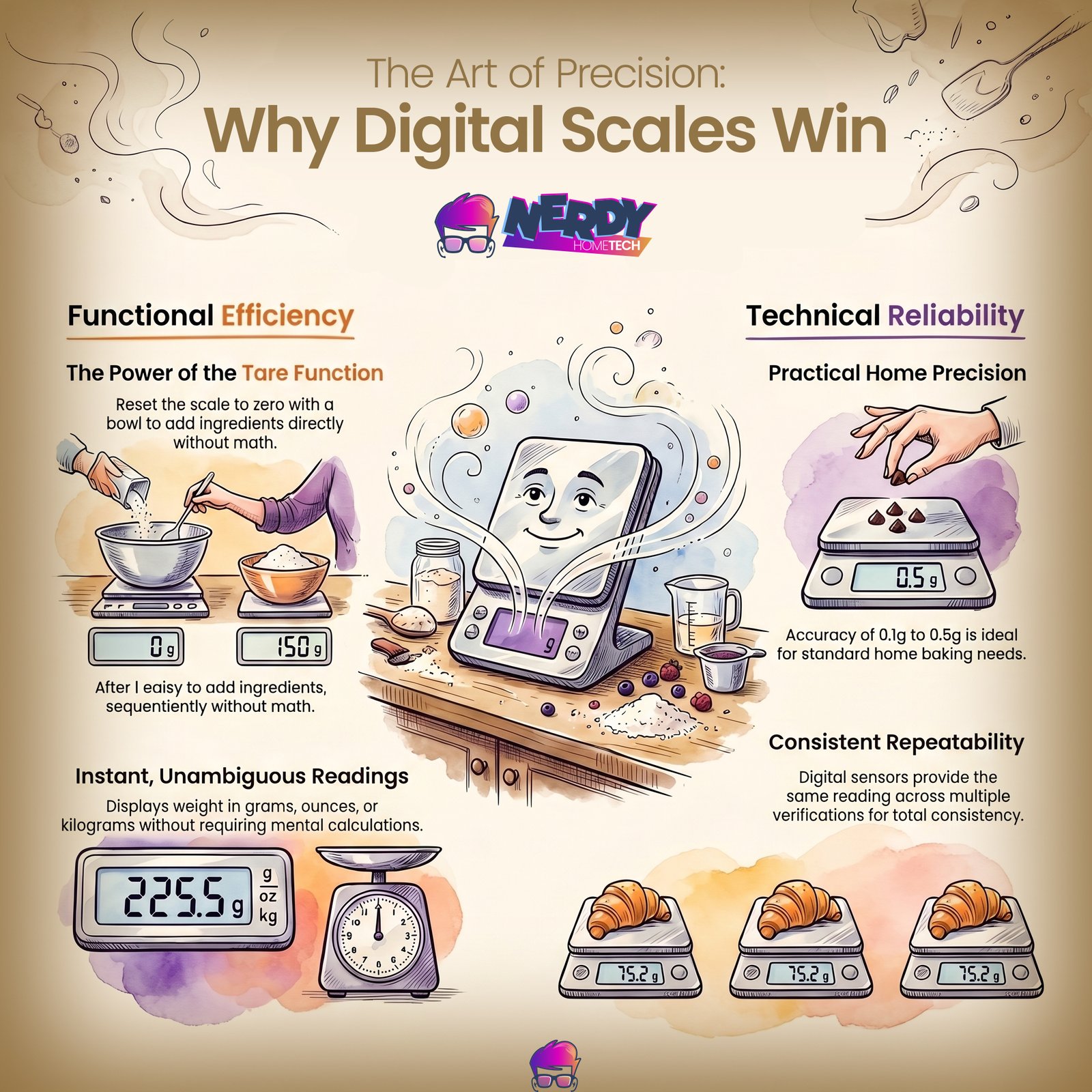
The Art Of Precision: Why Digital Scales Win. A Guide From Nerdy Home Tech.

Digital Scales: Convenience and Precision

A digital scale uses electronic sensors (strain gauges) to measure weight and displays the result on an LCD screen. No interpretation needed. No squinting at an analog dial from different angles.

What digital scales actually give you:

  • Instant, unambiguous readings in grams, ounces, pounds, or kilograms (depending on the model). No mental math required.
  • A tare function: place a bowl on the scale, hit tare, and the display resets to zero. Now you can add ingredients directly to the bowl without calculating cumulative weight. This saves cleanup and math errors.
  • Precision: most consumer digital scales measure to 0.1 or 0.5 gram accuracy, which is more than enough for home baking. You don’t need 0.01-gram precision for a loaf of bread.
  • Repeatability: digital scales are consistent run-to-run. You can verify the same weight ten times and get the same reading.

The real downsides:

  • Batteries. Most run on AAA or CR2032 batteries. They last months, but you’ll replace them.
  • Electronic failure. Drop a digital scale hard enough, and you might break the sensor. Get it wet at the wrong moment, and it might short. They’re less forgiving than mechanical scales.
  • Calibration: quality digital scales let you calibrate with a known weight (like a coin), but if it drifts out of calibration, you won’t notice until recipes start failing.
  • More complexity: if buttons break or the screen cracks, it’s often cheaper to buy a new scale than repair it.

Scale Decision Framework: Mechanical vs. Digital

Choose Mechanical If:

  • You bake rarely and want a tool that lasts forever.
  • You're in a high-risk environment (commercial or outdoor).
  • You're comfortable with mental math for unit conversions.
  • Precision for micro-quantities isn't a priority.
  • You value total mechanical simplicity over features.

Choose Digital If:

  • You bake regularly and need consistent, repeatable results.
  • You're handling precision-sensitive recipes (bread or pastry).
  • You want to eliminate mental math and speed up prep.
  • Counter space is limited—compactness is key.
  • You prefer grams as your native unit for accuracy.

What to Look For in a Digital Scale

Not all digital scales are created equal. Here’s what actually matters:

  • Measurement unit: Default to grams. Most home recipes are written in grams or can be converted easily. Scales that display grams clearly and first are easier to work with.
  • Accuracy: 0.1-gram or 0.5-gram precision is fine. Don’t pay extra for 0.01-gram scales—you don’t need that.
  • Tare function: Non-negotiable. This is how you reduce cleanup and mental math. Every digital scale worth buying has this.
  • Max weight: 2–5 kilograms is standard. Make sure it can handle a full mixing bowl plus ingredients.
  • Durability: Look for scales with rubberized feet or edges, sealed button panels, and a glass or stainless-steel platform. These details tell you the maker thought about durability.
  • Responsiveness: The scale should stabilize and show a reading within 2–3 seconds. If it takes ten seconds to settle, it’s a frustration every time you use it.

Avoid scales marketed as “professional” if they’re just the same generic scale with a sticker. Avoid scales with unnecessary features (Bluetooth, app connectivity) that add cost and complexity without solving a real problem.

Scales to Consider

Product Features Rating See Price
Amazon Basics
Amazon
  • Budget Friendly
  • 11 lbs Cap
  • 1 g Inc
  • None Interface
  • 2 x AAA Batteries (included) Power Requirement
  • 11 lbs (5000 g) Workflow Benefit
  • 1 g Hardware Specificity
92/100
Etekcity Stainless
Etekcity
  • Stainless Steel
  • 11 lbs Cap
  • 1 g Inc
  • None Interface
  • 2 x AAA Batteries (included) Power Requirement
  • 11 lbs (5000 g) Workflow Benefit
  • 0.05 oz (1 g) Hardware Specificity
90/100
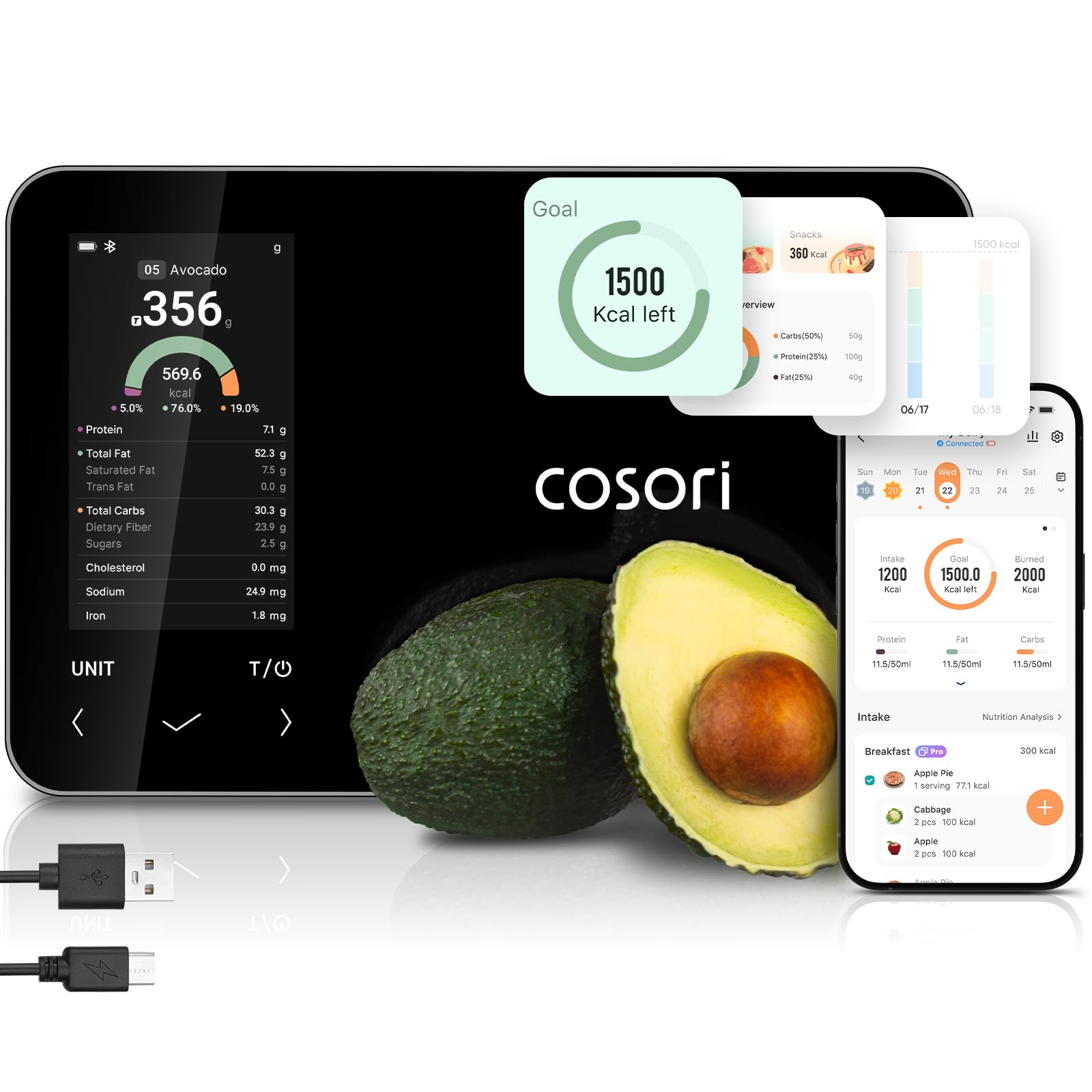
Cosori Nutrilens
Cosori
  • AI Food Scan
  • Rechargeable
  • 1 g Inc
  • Bluetooth / AI Scan App Interface
  • 800mAh Li-ion Rechargeable Power Requirement
  • 11 lbs (5000 g) Workflow Benefit
  • 1 g (0.1 oz) Hardware Specificity
89/100
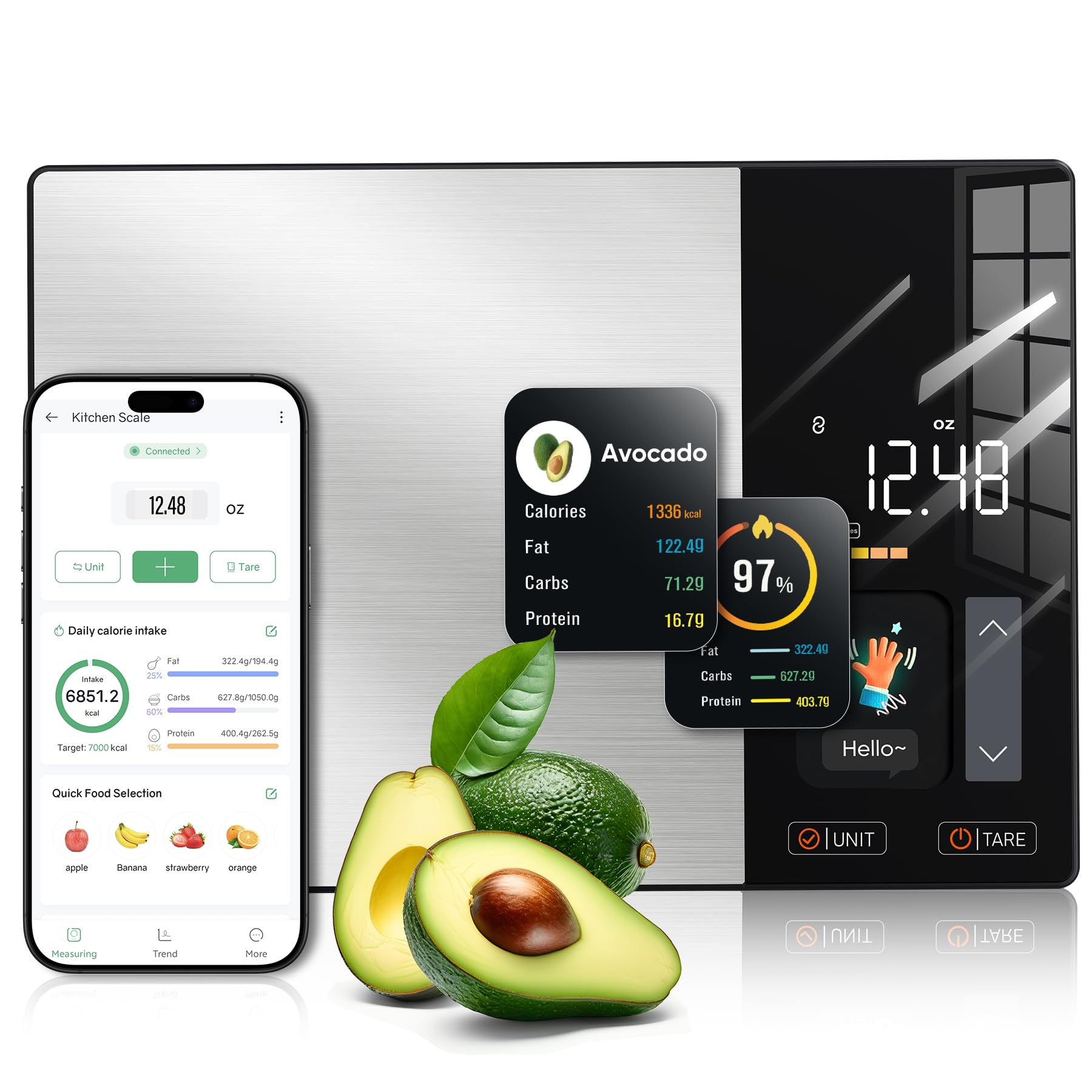
Etekcity Smart
Etekcity Smart
  • 19 Nutrients
  • Bluetooth
  • 11 lbs Cap
  • Bluetooth / VeSync App Interface
  • 3 x AAA Batteries (included) Power Requirement
  • 11 lbs (5000 g) Workflow Benefit
  • 1 g Hardware Specificity
88/100
KUAIVO Smart
Kuaivo
  • 23 Nutrients
  • TFT Display
  • 50 Foods Built-in
  • Bluetooth / App Interface
  • N/A Power Requirement
  • 11 lbs (5000 g) Workflow Benefit
  • 1 g Hardware Specificity
85/100
KitchenAid Dual
Kitchenaid
  • Two Platforms
  • 0.001 oz Inc
  • Dual Display
  • None Interface
  • N/A Power Requirement
  • 11 lbs (5000 g) and 1 lb (16 oz) Workflow Benefit
  • 0.1 oz and 0.001 oz Hardware Specificity
84/100
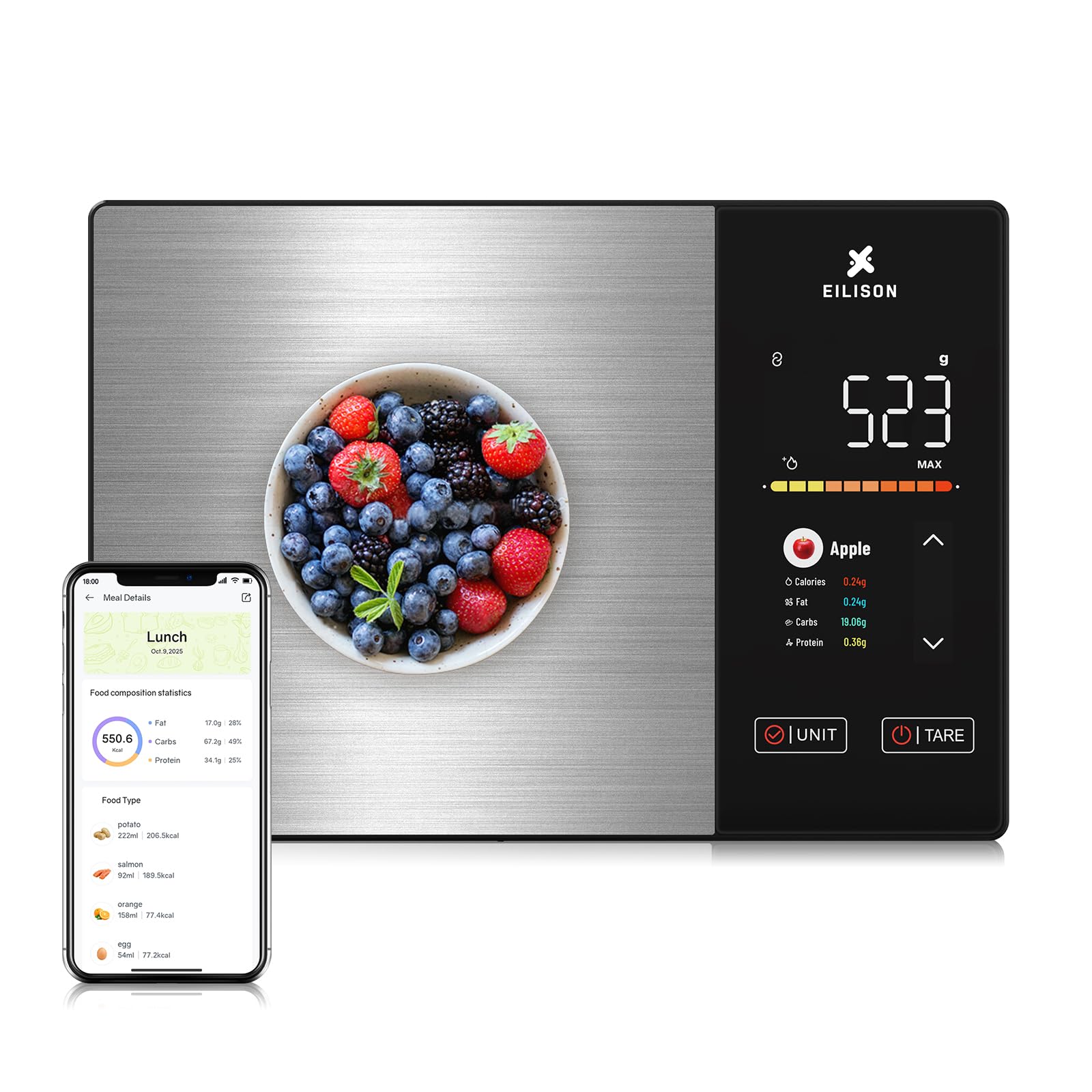
EILISON Color
Eilison
  • Touchscreen
  • 999+ Foods
  • 2 g Inc
  • Bluetooth / App Interface
  • N/A Power Requirement
  • 5000 g Workflow Benefit
  • 2 g Hardware Specificity
80/100

The Real Cost of Inconsistency

Here’s the thing that matters: every time you switch back to measuring cups after using a scale, you reintroduce variance. You’ll notice. Your bread will come out different. Your cakes will have texture issues you forgot you had.

Once you’ve baked with a scale for a month, going back feels like a step backward. That’s not snobbery—it’s just efficiency. You spend the same time measuring, but you get repeatable results.

If you’re baking once a year, measuring cups are fine. If you’re baking monthly or more, a digital scale pays for itself in reduced failed batches and mental friction.

MistakeWhy it mattersHow to avoid it
Not using the tare buttonThe bowl or container weight gets counted with your food.Place the empty bowl on the scale, press tare, then add your food.
Weighing on an uneven counterA tilted or wobbly surface can throw off the reading.Use the scale on a flat, steady counter before adding ingredients.
Adding more than the scale can holdToo much weight can cause wrong readings or damage the scale.Check the max weight limit and weigh large batches in smaller parts.
Using the wrong unitMixing grams, ounces, or pounds can ruin a recipe fast.Check the unit before you start and switch to the one your recipe uses.
Letting the display get coveredA large bowl can block the screen, making the weight hard to read.Use a wider, lower bowl or choose a scale with a pull-out display.
Weighing tiny amounts on a basic scaleSome scales cannot read small amounts like yeast, salt, or spices well.Use a scale with 0.1-gram precision for small baking amounts.

What’s Next

If you’re ready to switch, grab an affordable digital scale and run a side-by-side test on your next batch of cookies or bread. Measure the same recipe by cup and by gram. Look at the weight difference. That’s the source of your inconsistency.

You might find the variance is small enough that it never mattered. Or you might find it explains every baking frustration you’ve had for the past year.

Either way, you’ll know.

Frequently Asked Questions

Do food scales help with weight loss?

They can. Most people guess portions wrong, especially with oils, nut butters, granola, and sauces. A food scale cuts guesswork and helps you track calories or macros with more care. For weight loss, that steady tracking can make it easier to stay in a calorie deficit.

What’s the difference between a smart food scale and a regular kitchen scale?

A regular kitchen scale shows weight only. A smart food scale connects to an app, often through Bluetooth. This can help you log foods faster, scan barcodes, and track calories or macros. If you don’t want an app, a nutrition facts scale can show calories and macros on the scale itself.

Do I need a food scale if I use a meal delivery service?

Not always. Pre-portioned meal services already give you nutrition facts for each meal. A scale helps more if you cook from scratch or add your own sides, snacks, or sauces.

How accurate are smart food scales?

Most kitchen scales are accurate to 1 gram, which works well for meal prep and macro tracking. For tiny amounts, like coffee, spices, or powders, look for 0.1-gram precision. For best results, use the scale on a flat surface and press tare before weighing food.

What features should I look for in a food scale?

Look for clear buttons, a bright display, tare, unit changes, and a platform that fits your bowls. If you track meals, app support or built-in nutrition data can help. If you cook often, pick one that is easy to wipe clean.

Can I use a food scale for baking and meal prep?

Yes. A food scale is great for baking because grams are more exact than cups. It also helps with meal prep, since you can split rice, meat, veggies, and snacks into even portions.

How do I clean and care for a kitchen scale?

Wipe the scale with a damp cloth after each use. Don’t rinse it under water unless the maker says it is safe. Keep it dry, store it flat, and replace the batteries when readings start to act odd.

Elena Markovic
Elena Markovic

Elena Markovic is a technology journalist and editor from Zagreb, Croatia, with more than 20 years of experience covering consumer tech, smart homes, cybersecurity, and connected living. She holds a master’s degree in journalism and digital media and has written for tech publications, industry reports, buyer guides, and editorial teams across Europe and North America. Elena’s style is clear, practical, and research-driven—she doesn’t just explain what a gadget does, she helps readers decide if it’s actually useful. At Nerdy Home Tech, she covers smart home systems, security cameras, automation, voice assistants, energy-saving devices, and everyday tech that makes home life easier.

Nerdy Home Tech
Logo