
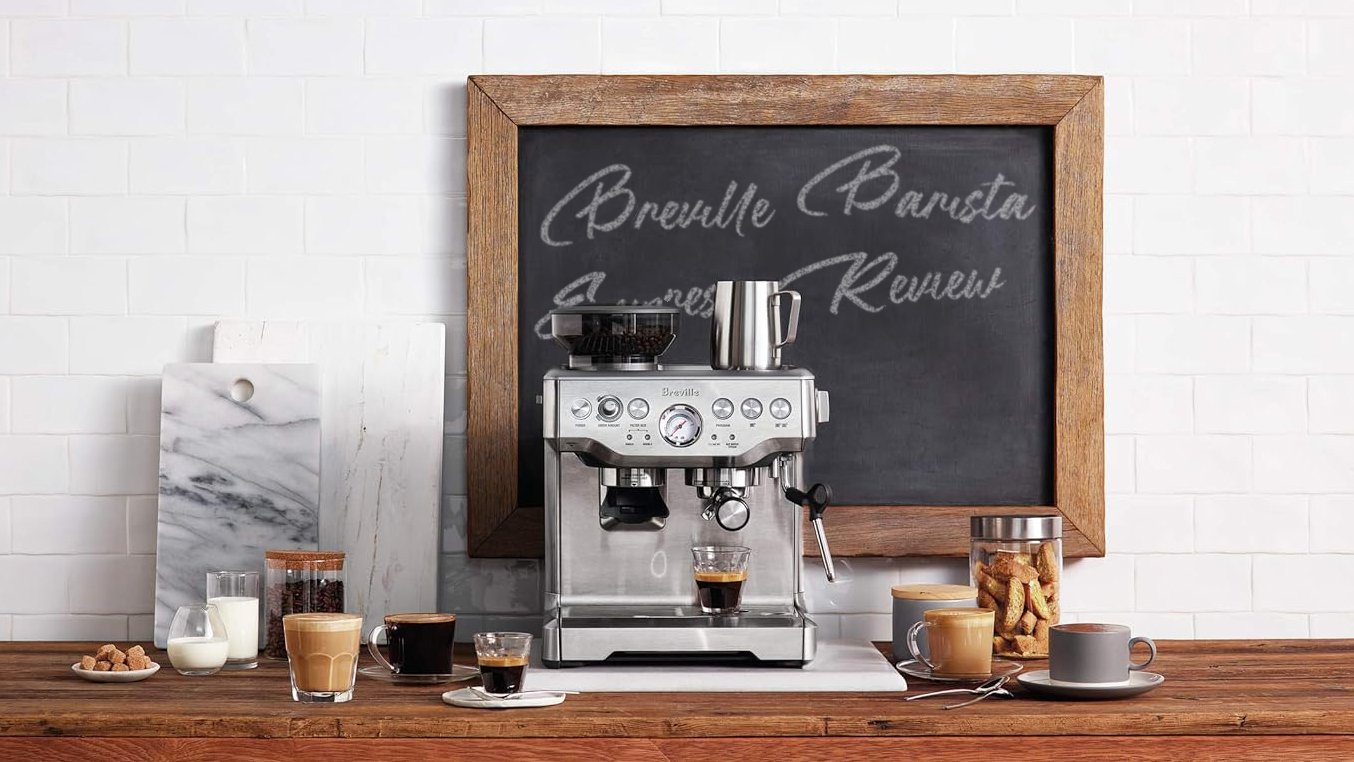
Nerdy’s Top Choice


Last updated on 2026-09-20
What Makes This Machine Special
The Breville Barista Express occupies a weird middle ground—and that’s exactly why it works. The grinder is excellent and well-suited to the job at hand, and the machine is designed from the ground up to do two things well: grind coffee and pull shots.
Most entry-level espresso machines force you to buy a grinder separately. That’s a $150+ problem on top of the machine itself. The Barista Express includes a conical burr grinder that’s actually good. It’s not a compromise add-on—it’s a real grinder.
The PID temperature control (Proportional-Integral-Derivative) is another differentiator. That fancy term means your brew water stays stable at whatever temperature you set it. This matters because espresso extraction is temperature-sensitive. Change the temp by 2°C and your shot gets noticeably different—too sour, too bitter, or just right. Most machines at this price skip PID entirely. You get it here.
The 15-bar Italian pump and thermocoil heating system work together to pull shots with actual body and crema—that caramel-colored foam on top that indicates proper extraction. Not all $500 machines can say that.
And honestly? The build quality is solid. Stainless steel housing, weighted portafilter, decent steam wand. Stainless steel thermoblock, metal grinder burrs, and reinforced portafilter scream longevity. This isn’t a machine that feels cheap.
The Grinder: Your Gateway to Espresso, and Your Ceiling
Let’s talk about the elephant in the room: the integrated grinder.
It’s good for learning. The 8-ounce hopper holds about 3–4 days of beans (if you’re a typical home user making 1–2 shots daily). The 18 grind settings range from coarse to fine, covering espresso territory. The conical burrs are stainless steel—durable and consistent.
Here’s the catch: those 18 settings are indexed, meaning they click into place. You can’t fine-tune between clicks. For a beginner learning to dial in for the first time, this is fine. You adjust grind, pull a shot, taste it, adjust again. Most people land on a setting that works and stick with it.
But if you’re making espresso daily, pulling different bean origins, and chasing specific extraction profiles—you’ll hit this grinder’s limits within 12–18 months. At that point, the 54mm washer which seals the portafilter to the machine will inevitably wear down after around 2 years of repeated use. You’ll start eyeing standalone grinders like the Baratza Sette 270 ($150) that offer finer control.
For the first year? The grinder is fine. For long-term espresso obsession? Plan to upgrade.
Noise is moderate—not silent, not obnoxiously loud. Espresso grinders generally aren’t quiet; this one is quieter than many.

Brewing, Temperature, and the Pre-Infusion Detail
The PID temperature control lets you adjust brew water between 86–96°C (187–205°F). Start in the middle (91°C) and dial from there.
Light roasts?
Go cooler (88–90°C) to avoid over-extraction and highlight brightness.
Dark roasts?
Go warmer (93–96°C) to pull more body and sweetness.
This simple temperature control is the reason even mediocre technique pulls decent shots. A machine without PID would amplify every mistake.
The pre-infusion system gradually ramps up pressure at the start of extraction. For the first ~10 seconds, the pump delivers lower pressure, letting water soak into the coffee grounds evenly. This prevents channels (uneven paths where water rushes through, pulling sour shots). It’s a small thing that makes a big difference.
You can override this in manual mode by holding the brew button yourself, which is useful if you want to experiment with different pre-infusion times. Most beginners don’t touch this. The default ~10 seconds works fine.
Heat-up time is roughly 30 seconds to 2 minutes depending on whether the portafilter and group head are warm. Preheat by running water through the empty group head for 5 seconds before you insert the basket. This small step prevents temperature drop during extraction and improves consistency significantly.
Pro tip from testing: Warm your drinking cup with hot water while the machine heats. Pour the warm water out right before pulling the shot. It sounds fussy but it genuinely improves the final espresso temperature and flavor by the time it reaches your mouth.
Steam Wand and Milk: Practice Required
The steam wand is powerful—capable of real microfoam for latte art. But there’s a learning curve.
The wand works on full steam pressure, which is effective but less forgiving than wands on $2,000 machines. Your technique matters. Angle wrong and you’ll get big bubbles instead of silky foam. Most people need 20–40 repetitions to pull consistently good microfoam. Some catch on faster. Some slower.
The wand doesn’t rotate 360°, which is a minor limitation. On some machines you can position it however you want; here you get a fixed angle that works but isn’t ideal for everyone.
After steaming, purge the wand immediately (press the steam button for a second without the pitcher attached) and wipe it with a damp cloth. Milk residue hardens inside and blocks the nozzle. It’s a 10-second task that prevents frustration.