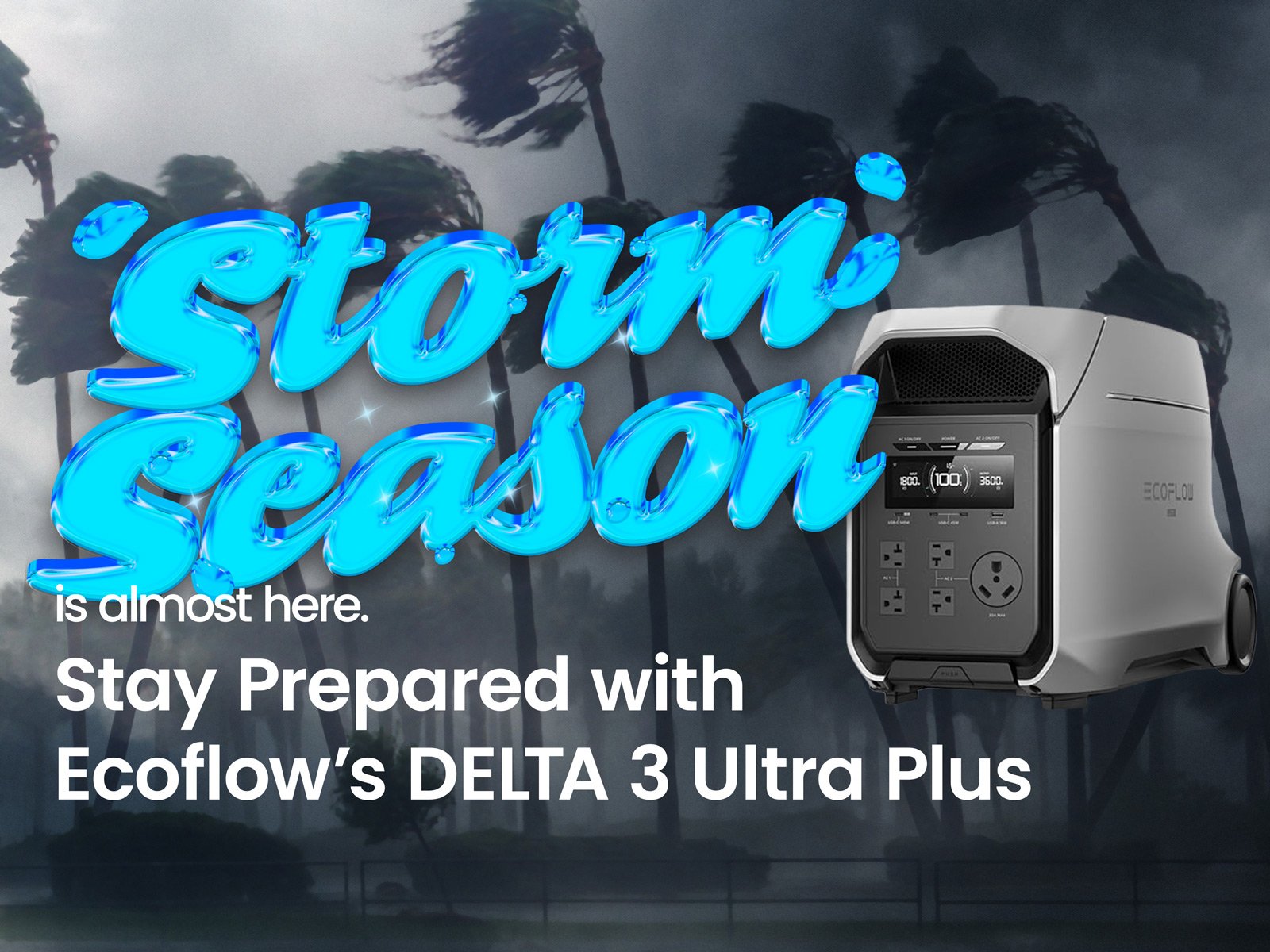
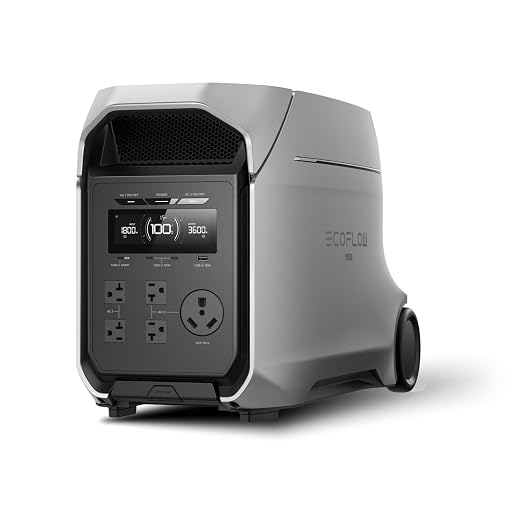
EF ECOFLOW DELTA 3 Ultra Plus Portable Power Station
Real-World Runtimes: What to Actually Expect
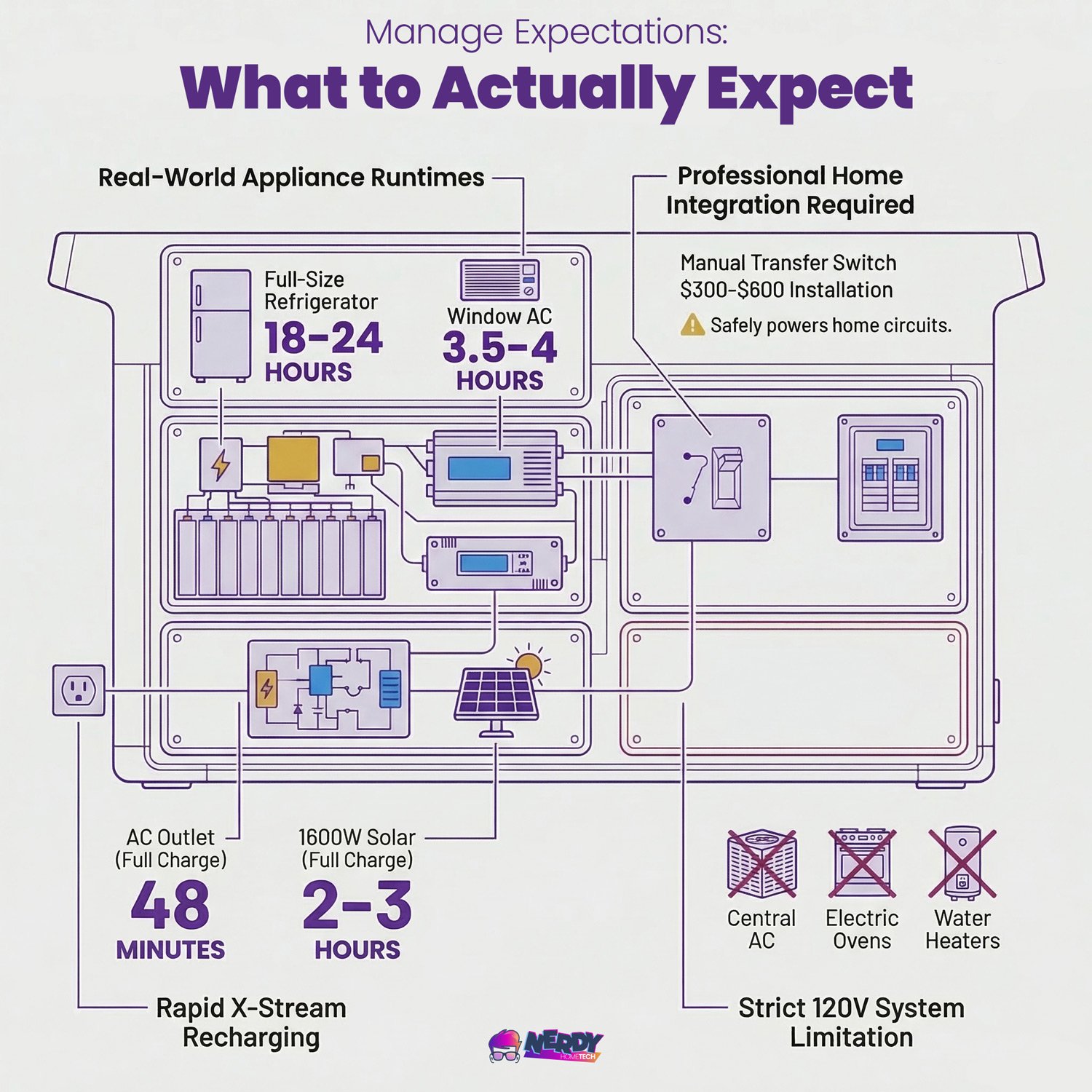
When assessing this unit for emergency backup, you need to manage your expectations regarding what 3072Wh can actually accomplish.
To put that capacity into perspective: this will run a standard, energy-efficient full-size refrigerator (which cycles on and off) for approximately 18 to 24 hours. A standard Wi-Fi router will stay online for over a week. A 10,000 BTU window AC unit? You’re looking at roughly 3.5 to 4 hours of continuous runtime before the battery dies.
When depleted, EcoFlow’s X-Stream architecture pulls up to 1800W from a standard AC wall outlet, yielding a full charge in approximately 48 minutes. Solar charging maxes out at 1600W via dual MPPT controllers (built-in regulators that maximize the speed and efficiency of the incoming solar charge). Under optimal solar conditions with a full 1600W array, expect a full charge in approximately 2 to 3 hours.
Connecting appliances directly to the unit is plug-and-play. However, integrating it into your home circuits requires a manual transfer switch (a wall-mounted panel, installed by an electrician, that safely connects the battery to your home’s circuit breakers without backfeeding the grid). Expect to pay an electrician between $300 and $600 for the labor and materials to install a basic transfer switch.
Because this is strictly a 120V system, 240V appliances are definitively off-limits. You can’t power central AC, an electric water heater, an electric oven, or a Level 2 EV charger with this unit.
Software Ecosystem: Expectations vs. Reality
Integration with existing smart platforms is where the DELTA 3 Ultra Plus earns its smart-home credentials, but it comes with strings attached. The free EcoFlow app (available on iOS and Android with no required subscription) enables features like Time-of-Use (TOU) arbitrage. This allows you to program the unit to charge from the grid when electricity is cheap, and discharge to run your house when grid rates spike.
It also features “Smart Output Priority,” which acts as automated energy triage, letting you program the unit to cut power to your entertainment center when the battery hits 30%, preserving the remaining charge for your refrigerator.
However, the heavy reliance on the cloud is a vulnerability. The highly marketed “Storm Guard Mode” relies on Wi-Fi to monitor meteorological data and force a 100% charge 24 hours before a severe weather event. Critics rightly point out that a total ISP failure before a storm is the exception, not the rule, meaning the feature will work as intended for the vast majority of users.
Even so, requiring a persistent server handshake for a critical disaster-preparedness feature is a fundamental design flaw. True off-grid reliability should never require an active ping to a corporate server.
The X-Boost and Floating Ground Pitfalls
I need to explicitly highlight two technical realities that marketing materials often gloss over.
First is the X-Boost 3.0 technology. This feature algorithmically depresses the output voltage to allow the 3600W inverter to operate higher-wattage resistive appliances (up to 4600W). While this is a clever workaround for running a heavy space heater, it introduces a severe risk. X-Boost intentionally drops the voltage to keep the wattage within limits.
While a basic heating coil won’t care, this fundamental incompatibility presents a real risk of hardware damage to voltage-sensitive precision instruments like desktop computers or medical equipment. This isn’t guaranteed to destroy your devices, but the risk is unnecessary. Always disable X-Boost in the app if you aren’t running purely resistive loads.
Second, the DELTA 3 Ultra Plus uses a floating ground topology (a safety design where the electrical ground isn’t physically tied to the earth, which is standard for portable stations). If you plug a standard diagnostic outlet tester into this unit, it will likely report that the Live and Neutral lines are reversed. In a floating off-grid topology, both lines are inherently live.
While perfectly safe for isolated use, this topological mismatch confuses standard grid testing equipment. This can complicate integration if you’re using a manual transfer switch without a switched neutral. Local electrical codes and inspectors may see this differently, so consult a certified electrician before hardwiring it into your panel.
DELTA 3 Ultra Plus vs. DELTA Pro 3
The most direct head-to-head comparison within the same ecosystem is EcoFlow’s own DELTA Pro 3. The decision between the two EcoFlow models comes down to an \$800 price gap and your specific voltage requirements.
The DELTA Pro 3 ($3,699) is a much heavier, taller unit (113.5 lbs) that natively supports split-phase output (the ability to output 240V, which is required for heavy home infrastructure like electric dryers or well pumps). If you absolutely must power a 240V appliance, the Pro 3 is the mandatory choice. It also scales massively up to 48kWh. Conversely, the DELTA 3 Ultra Plus ($2,899) appeals to users who only need to secure 120V circuits and prefer a lower upfront capital expense.
| Feature Comparison | EcoFlow DELTA 3 Ultra Plus ($2,899) | EcoFlow DELTA Pro 3 ($3,699) |
|---|---|---|
| Target Audience | Apartment dwellers and homeowners securing standard 120V essentials. | Large properties requiring whole-home 240V integration. |
| AC Voltage Support | 120V Only (cannot power 240V appliances natively). | 120V / 240V Split Phase (native support for heavy infrastructure). |
| Maximum Scalability | Expands up to 11kWh (supports 1 extra battery, approximately $1,599). | Expands up to 48kWh (supports multiple extra batteries and generators). |
| Form Factor & Portability | Compact / Low profile (74.3 lbs). Easier to fit in SUV trunks. | Tall, bulky form factor (113.5 lbs). Difficult for one person to lift. |

EF ECOFLOW DELTA Pro 3 Portable Power Station

Broader Market Comparison: Anker and Jackery
While the EcoFlow ecosystem is robust, buyers should cross-shop the broader market before committing. The 3kWh-to-4kWh capacity tier is highly competitive, and two direct alternatives stand out for vastly different reasons: the Anker SOLIX F3800 Plus and the Jackery HomePower 3600 Plus.
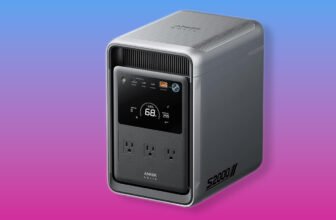
Anker SOLIX F3800 Plus Portable Power Station

The Anker SOLIX F3800 Plus prioritizes raw output and native heavy-appliance support over compact portability. Unlike the DELTA 3 Ultra Plus, the Anker unit natively outputs 120V/240V split-phase power straight from the unit. This means you can plug a standard EV charger or an electric dryer directly into it without needing a secondary hub.

The tradeoff is a severe weight penalty. At over 130 pounds, it requires two people to move safely, effectively eliminating the “portable” aspect for everyday use.
| Key Feature | Primary Benefit |
|---|---|
| Native 120V/240V Output | Directly powers heavy home infrastructure (well pumps, dryers) without extra accessories. |
| 6000W AC Output | Massive continuous load limit handles multiple high-draw appliances simultaneously. |
| Direct EV Charging Port | NEMA 14-50 port built directly into the chassis for straightforward electric vehicle topping. |

Anker SOLIX F3800 Plus Portable Power Station
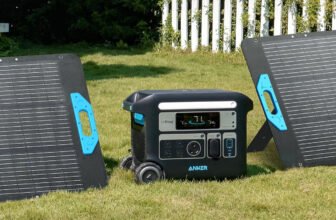
Jackery HomePower 3600 Plus Portable Power Station
The Jackery HomePower 3600 Plus takes the opposite approach, targeting the plug-and-play crowd who prefer simplicity over granular technical control. It sacrifices some of EcoFlow’s advanced cloud automation features in exchange for a foolproof interface and highly durable hardware.
The downside is that its UPS switchover time is typically slower (often around 20ms), which might cause sensitive desktop computers to reboot during a power flicker. It’s better suited for keeping refrigerators and lights running rather than serving as an uninterrupted IT backup.
| Key Feature | Primary Benefit |
|---|---|
| Simplified UI / App Interface | Exceptionally easy to operate for non-technical users during high-stress emergencies. |
| Foldable Handle Design | Enhances actual portability and makes vehicle packing significantly easier. |
| Hardware Durability | Industry-leading physical chassis resilience against bumps and drops. |

Jackery HomePower 3600 Plus Portable Power Station
The 3kWh Tier Matrix Comparison
Here is how the core hardware and software capabilities stack up when placing these three units side-by-side.
| Primary Feature | EcoFlow DELTA 3 Ultra Plus | Anker SOLIX F3800 Plus | Jackery HomePower 3600 Plus |
|---|---|---|---|
| Base Battery Capacity | 3072Wh | 3840Wh | 3600Wh |
| Voltage Capabilities | 120V Only | 120V / 240V Split Phase | 120V Only |
| Continuous AC Limit | 3600W | 6000W | 3600W |
| App / Software Profile | Highly automated, cloud-dependent (Storm Guard, TOU) | Functional management, moderate automation | Basic, offline-friendly, straightforward |
Purchase Economics and Legislation
It’s crucial to acknowledge the current macroeconomic landscape. Earlier this year, lawmakers debated the proposed One Big Beautiful Bill Act (OBBBA), which targeted the termination of the 30% residential clean energy tax credit.
As of March 2026, the final legislative updates clarify that 2026 is the last year to apply for the solar tax credit. Because the credit wasn’t immediately terminated on January 1, 2026, buyers who purchase and install their system this year can still claim the 30% federal subsidy (IRC Section 25D). Note that eligibility for Section 25D typically requires permanent installation—consult a tax professional to confirm whether a portable, non-hardwired unit qualifies before treating this as a guaranteed return.
However, with the phase-out now scheduled for the end of the year, the return-on-investment calculation shifts significantly. The lower initial cost of the DELTA 3 Ultra Plus makes it a much more attractive option for budget-conscious buyers aiming to secure their backup power before the credit disappears entirely.
Balancing the Advantages and Disadvantages
Every design choice requires a compromise. The following table illustrates the direct trade-offs inherent in the DELTA 3 Ultra Plus architecture. This isn’t a flawless device; it’s a highly capable tool with specific operational boundaries.
| Primary Advantage | Corresponding Technical Disadvantage |
|---|---|
| Cloud-mediated predictive automation (Storm Guard, TOU routing). | Complete feature failure if local ISP or home Wi-Fi drops during an emergency. |
| X-Boost allows running appliances beyond the 3600W inverter limit. | Intentional voltage depression poses a serious risk to sensitive electronics. |
| Sub-10ms Uninterruptible Power Supply (UPS) auto-switching. | Firmware requires the unit to constantly trickle-charge, potentially causing parasitic drain (slow battery discharge even when nothing is plugged in) and clicking noises when idle. |
| Floating ground topology allows for a lighter, more portable internal inverter. | Fails standard diagnostic tests, confusing users and complicating safe transfer switch integration. |
Technical Specifications Breakdown
For those looking strictly at the numbers, here is how the baseline hardware limits compare to its larger sibling. Keep in mind that lab-tested specifications often represent best-case scenarios. Real-world continuous loads, especially in high-heat environments, will yield shorter runtimes.
| Specification | EcoFlow DELTA 3 Ultra Plus | EcoFlow DELTA Pro 3 |
|---|---|---|
| Base Battery Capacity | 3072Wh (3 kWh) | 4096Wh (4 kWh) |
| Continuous / Surge Power | 3600W / 7200W | 4000W / 8000W |
| Maximum Solar Input | 1600W (Dual 800W MPPT controllers) | 2600W (Mixed high and low PV inputs) |
| USB-C Power Delivery | 1x 140W, 2x 45W | 2x 100W |
| Chassis Dimensions | 15.6 x 12.9 x 24.1 inches | 27.3 x 13.4 x 16.1 inches |
Final Verdict
The EcoFlow DELTA 3 Ultra Plus is a practical, high-capacity power station that lowers the entry price for smart-home energy management. It’s an excellent choice if your primary goal is keeping 120V refrigerators, routers, and essential lighting alive while minimizing upfront costs.
However, you must respect its limitations. The cloud dependency, the strict 120V restriction, and the voltage quirks of X-Boost mean this is an active management tool, not a “set it and forget it” magic box. Approach it with realistic runtime expectations, and it will serve you exceptionally well.
At $2,899, it balances capacity against cost more effectively than the Pro 3 for 120V-only use cases. If you’re ready to secure your home’s basic power needs before the next storm season, you can buy the EcoFlow DELTA 3 Ultra Plus here.
EF ECOFLOW DELTA 3 Ultra Plus Portable Power Station
Features
| Brand | EF ECOFLOW |
| Wattage | 3600 watts |
| Fuel Type | Solar |
| Power Source | Solar Powered |
| Recommended Uses For Product | Camping, Residential |
| Item Weight | 74 Pounds |
| Output Wattage | 3600 |
| Special Feature | Portable |
| Included Components | DELTA 3 Ultra Plus |
| Product Dimensions | 24.1"L x 12.9"W x 15.6"H |
| Material | Metal (Likely Steel Or Aluminum), Plastic, Rubber |
| Model Name | DELTA 3 Ultra Plus |
| Engine Type | Inverter |
| Total Power Outlets | 2 |
| Running Wattage | 3600 Watts |
| UPC | 842783192059 |
| Manufacturer | ECOFLOW |
| Item Weight | 74 pounds |
| ASIN | B0FQVG59LV |
| Item model number | EF-DL-H02-3UP |
 Walmart.com