
If your gear lives on USB-C and you’re tired of hauling a brick, the Jackery Explorer 240D makes a pretty strong case for going lighter.
The Jackery Explorer 240D feels like a direct answer to anyone who’s outgrown bulky AC power stations. By ditching the inverter and focusing on DC-powered devices, it keeps the size and weight down while still giving you enough output for the kind of gear most people actually carry these days. The trade-off is real, though, and that’s where this review starts.
The trade-off is simple: you get portability, but you lose the AC outlet.

Last updated on 2026-09-16
Key Takeaways
- DC-Native Efficiency: No 110V AC outlet means no conversion loss. With a 95% DC-to-DC efficiency rate, you get more actual runtime for your laptops compared to stations that waste energy turning DC into AC and back again.
- The 6,000 Cycle Claim: While Jackery markets a LiFePO4 battery rated for 6,000+ cycles, real-world longevity depends heavily on the unit’s internal BMS and electronics, which have seen mixed reliability in early reviews.
- Weight-to-Power King: At 4.85 pounds, it is 70% smaller than AC-equipped stations like the Explorer 240 v2, making it a strong contender for weight-conscious travelers.
- 140W Power Delivery: One USB-C port handles 140W—perfect for fast-charging high-end laptops or the upcoming Valve New Steam Controller.
What the Jackery Explorer 240D Is (and Isn’t)
The most striking feature of the Explorer 240D is what’s missing: a traditional AC wall-style outlet. The Explorer 240D does not have one. If you need to run a coffee maker, a hair dryer, or a CPAP machine that requires a standard 110V plug, this unit is effectively a paperweight.
If you mainly charge laptops, drones, and phones, the DC-only design is actually the point. By staying within DC restraints, the 240D ensures more of its 256Wh capacity actually reaches your battery rather than being lost as heat during conversion.
Design: The 2-in-1 Secret Weapon
The engineering here is refreshingly pragmatic. The 240D stands just 6.7 inches tall. The cleverest bit? The carrying handle. It isn’t just a plastic strap; it detaches to become a high-spec 140W USB-C cable. The detachable handle is genuinely useful because it also doubles as a 140W USB-C cable.
Port Layout and Output Specs
You get a total of four usb ports to juggle:
| Port Type | Specification |
|---|---|
| USB-C1 | Up to 140W (bi-directional PD 3.1) |
| USB-C2 | Up to 100W |
| USB-C3 | Up to 15W |
| USB-A | Up to 18W |
With a total output of 200W DC, you can technically charge a laptop, a tablet, and two phones simultaneously without the unit breaking a sweat.
Under the Hood: The LiFePO4 Advantage
The 240D uses LiFePO4 cells, which is a good sign for long-term durability.
Compared to older “lithium-ion” (NMC) units, LiFePO4 is safer and more durable. Jackery claims a 10-year lifespan, but there is a catch. While the cells themselves might handle 6,000 cycles, some users have reported the unit failing to take a charge after less than 365 cycles—suggesting the internal Battery Management System (BMS) might be the true weak link.
Is the 12V Output Regulated?
A common “nerdy” question: does the voltage drop as the battery dies? Since this is a DC-focused station, stable voltage is paramount. The internal BMS provides a stable 12.8V output, ensuring your sensitive electronics or a 12V portable fridge won’t shut down prematurely due to “low voltage” sag—a common headache with cheap power banks.
The Reality Check: Where It Falls Short
The 240D has a few drawbacks worth knowing before you buy.
The Display & Electronics “Glitches”
User data from “Brutal Reviews” and Reddit highlights erratic battery percentage displays, sometimes jumping by 10% suddenly. Others have noted the cooling fan kicking on even when the unit isn’t under load, signaling that the supporting electronics may feel more “budget” than the cells themselves.
Charging Constraints
Recharging can be slow if you aren’t using high-wattage adapters. While it supports dual AC/DC input for an 80% charge in one hour, using a standard 60W MacBook brick will take significantly longer.
Customer Support and Documentation
Jackery’s support can be hit-or-miss, with some users describing warranty replacements as a months-long ordeal. Additionally, the user manual has been criticized for grammatical errors and misleading technical info—a major red flag for an emergency tool.
Best for Fast Charging Innovation

EF ECOFLOW RIVER 3
A lightweight, compact power station that recharges fully in just one hour, making it ideal for camping, home backup, and RV use. Its multiple output ports and optional solar charging compatibility keep you powered across a wide range of devices and scenarios.
View Specs & Features
Key Benefits
- Quick 1-hour recharge keeps you moving without long waits
- Reliable 245Wh LiFePO4 battery offers longevity and safety
- X-Boost feature allows powering devices up to 600W for flexibility
- Multiple output ports cover devices from phones to small appliances
Special Highlights
- Compatible with optional solar panels for renewable off-grid recharging
- Whisper-quiet operation suitable for both indoor and outdoor use
- LiFePO4 chemistry provides enhanced thermal stability over standard lithium-ion
| Battery Capacity | 245Wh LiFePO4 |
| Output Power | 300W (600W X-Boost Surge) |
| Recharge Time | 1 Hour (AC) |
| Solar Charging | Yes (panel sold separately) |
| Weight | 7.8 lbs |
Best Value Performance

BLUETTI EB3A
The BLUETTI EB3A charges from zero to 80% in just 30 minutes and delivers 600W of output with completely silent operation. It handles power outages, camping trips, and travel with equal ease while supporting both solar and AC recharging.
View Specs & Features
Key Benefits
- 30-minute fast charge (0-80%) minimizes downtime in critical moments
- Strong 600W output supports multiple devices running simultaneously
- Silent operation keeps your environment peaceful indoors and out
- Solar and AC charging options provide flexible recharge sources
Special Highlights
- 1200W surge capacity handles more demanding appliances and gadgets
- LiFePO4 battery rated for thousands of charge cycles, reducing replacement costs
- Efficient inverter technology minimizes energy waste during use
| Battery Capacity | 268Wh LiFePO4 |
| Output Power | 600W (1200W Surge) |
| Recharge Time | 30 Minutes (0-80%) |
| Solar Charging | Yes |
| Weight | 10.1 lbs |
Best Compact Power Bank

Anker PowerCore Reserve 192Wh
A compact 192Wh power bank with a smart digital display, retractable auto lighting, and a built-in SOS mode for emergencies. At just 5.76 lbs, it delivers steady 87W output and is easy to bring along for travel, camping, or home backup.
View Specs & Features
Key Benefits
- Compact and lightweight design makes it easy to carry anywhere
- Digital display gives real-time visibility into remaining battery status
- Built-in retractable lighting with SOS mode reduces the need for extra gear
- Multiple ports support a variety of devices including laptops
Special Highlights
- Lightest unit in the roundup at 5.76 lbs for true grab-and-go portability
- Battery protection system guards against overcharging, overheating, and short circuits
- SOS lighting mode adds critical emergency signaling capability
| Battery Capacity | 192Wh Li-Po |
| Output Power | 87W |
| Lighting | Retractable Auto Light with SOS Mode |
| Display | Smart Digital Display |
| Weight | 5.76 lbs |
Best Solar Charging Efficiency
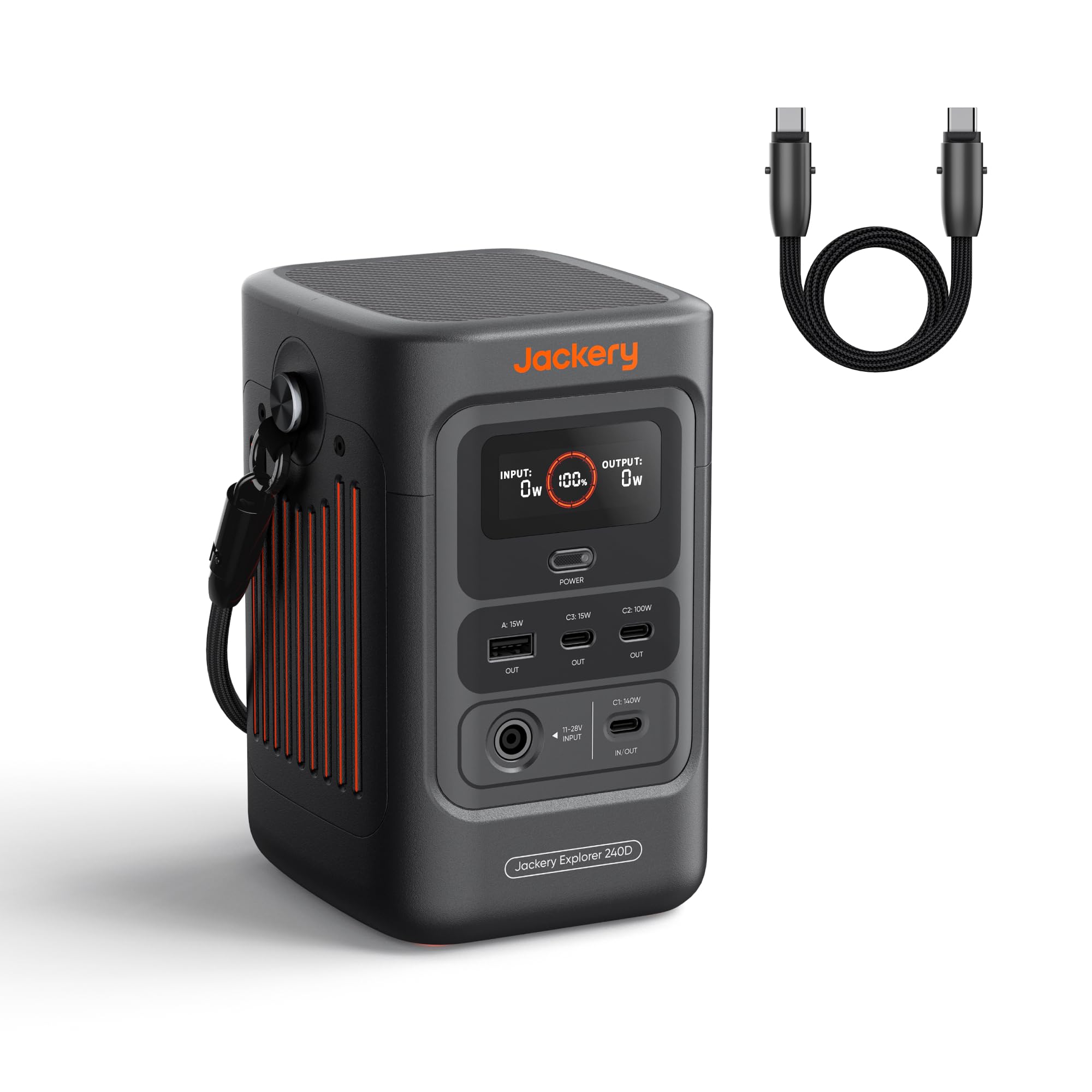
Jackery Explorer 240D
The Jackery Explorer 240D packs a 256Wh LiFePO4 battery and 1-hour fast charging into a compact, lightweight build perfect for camping, travel, and emergencies. Its 200W DC output and solar compatibility make it a practical and versatile off-grid power solution.
View Specs & Features
Key Benefits
- 1-hour fast charging significantly reduces downtime between uses
- 256Wh LiFePO4 battery delivers dependable, long-lasting power storage
- Compact design at 6.6 lbs makes it easy to carry and store
- Multiple ports charge phones, laptops, and small devices simultaneously
Special Highlights
- Solar panel compatible for sustainable off-grid recharging on extended trips
- LiFePO4 chemistry includes built-in protection against overcharging and short circuits
- Balanced combination of capacity, weight, and charge speed among similarly sized stations
| Battery Capacity | 256Wh LiFePO4 |
| Output Power | 200W DC |
| Recharge Time | 1 Hour |
| Solar Charging | Yes (panel compatible) |
| Weight | 6.6 lbs |