

Why portable inverter generators make sense for short-term backup power
When the power goes out, most people don’t need a whole-home standby generator. They need a temporary, manageable way to keep food cold, phones charged, the internet up, and a few critical devices running until utility power returns.
That’s the lane for a portable inverter generator. It isn’t a whole-house solution. It isn’t maintenance-free. It isn’t right for every home. But for storm outages and temporary backup scenarios, it can be the most practical tool in the middle ground between doing nothing and installing a permanent standby system.
How I’m framing this guide
This guide is focused on portable inverter generators in the small-to-mid-size range for temporary storm and outage backup, not full-home standby systems and not large construction-style generators meant mainly for jobsite duty.
The emphasis here is on the things most buyers actually care about during a power outage:
- keeping refrigeration running
- maintaining internet and communication
- supporting a few comfort loads such as fans
- covering selected emergency loads like a CPAP, sump pump, or furnace blower
- doing all of that with better power quality and lower noise than a basic open-frame generator usually delivers
This is not a guide for people trying to run central air, a whole electric kitchen, an electric dryer, or a house as though the outage never happened. If that’s your expectation, you’re shopping in the wrong category.
How to use this guide like a buyer, not a browser
A serious generator purchase comes down to four questions:
- What do you absolutely need to run during an outage?
- How much startup surge do those loads create?
- Do you want lower noise and cleaner power badly enough to pay the inverter premium, and are you willing to store fuel and maintain the machine?
- Do you need a temporary backup tool, or are you quietly trying to solve a bigger whole-home problem with the wrong equipment?
If you don’t answer those honestly, you’ll end up with the wrong generator.
Who should buy a portable inverter generator
A lot of bad generator purchases come from people trying to force a small inverter generator into a role it was never built to fill.
It’s a good fit if you:
When you should skip this category entirely
This is one of the biggest omissions in weak buyer guides, so let’s fix it directly.
You should probably skip a small portable inverter generator and consider a different backup path if:
- your home depends on a deep-well pump that needs 240V
- you expect to power fixed circuits regularly and want a cleaner panel-based backup setup
- you rely on central air, electric heat, or large electric appliances during outages
- you won’t maintain fuel equipment consistently
- If a medical device is essential, your backup plan should include redundancy, battery fallback, and a tested routine rather than relying on a single fuel-powered machine.
In those cases, a larger 240V-capable generator, a professionally planned backup system, or a battery-plus-inverter setup may be the more honest answer.
Inverter vs. conventional: what actually matters
A conventional open-frame generator still has a valid place in the market. In practice, the differences come down to this:
- conventional generators usually give you more watts per dollar and more noise
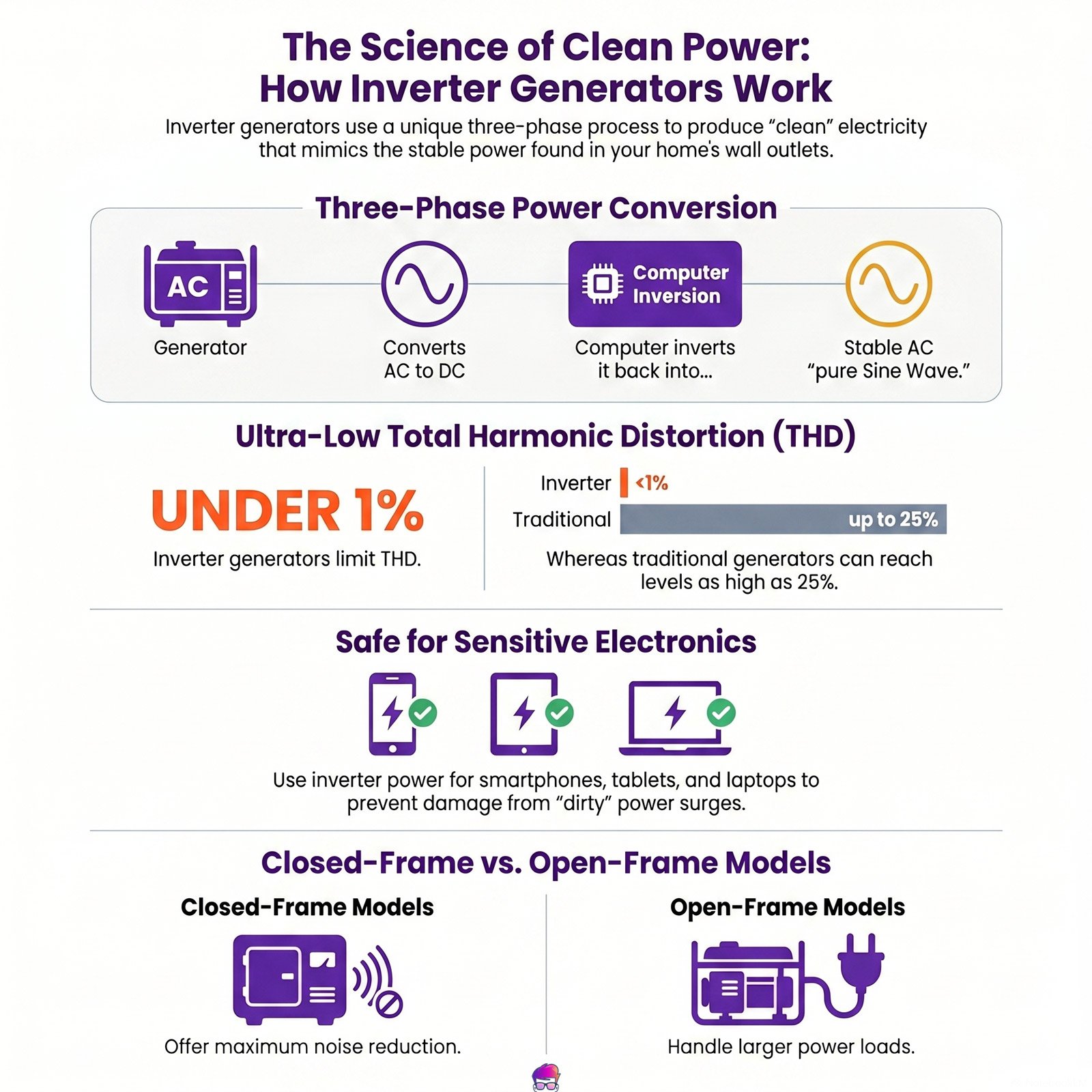
- inverter generators usually give you cleaner power, lower noise, and better light-load efficiency
Many inverter generators are designed to provide cleaner power than conventional generators, which is one reason they’re often preferred for electronics-heavy backup use.
If you’re powering pumps, tools, or rough outdoor loads, conventional can still be the better value. If you’re powering refrigeration, networking gear, and electronics, inverter is usually the better fit.
Clean power, noise, and the limits of category claims
Inverter generators are generally favored for cleaner output and lower harmonic distortion, which is one reason they’re so commonly recommended for electronics-heavy backup use. But buyers should understand something important: category-level claims are not a substitute for model-level verification.
A good inverter generator often delivers cleaner output than a cheap conventional unit. That does not mean you should blindly trust a generic category claim more than the actual specs and behavior of the model you’re buying.
The same caution applies to noise. Inverter generators are usually quieter than open-frame generators, but “quiet” is relative. A model that sounds fine at 25% load may be a different story when a refrigerator, sump pump, and fan all stack up under real storm conditions.
Running watts vs starting watts
This is where buyers either make a smart decision or waste money.
Running watts are what a device needs once it’s operating normally. Starting watts are the higher short-duration surge some devices need when a motor first kicks on. Refrigerators, freezers, sump pumps, furnace blowers, and window AC units all bring startup surge into the equation.
Generator disappointment usually isn’t about steady-state load. It’s about startup conflict. A setup that looks fine on paper can still fail when a fridge compressor starts at the same moment as a pump or blower.
A practical rule is to keep your expected running load around 50% to 70% of the generator’s capacity rather than shopping right up to the top number and pretending you’ve left yourself margin.
Most small inverter generators are 120V only
Most inverter generators in the 2,000W to 4,000W class are 120V machines. They can power standard household outlets and selected loads, but they generally cannot handle large 240V appliances such as electric dryers, ranges, central AC systems, or many well pumps.
If you’re planning to power those loads, stop trying to make a suitcase inverter generator solve a 240V backup problem. That’s how people end up with false confidence and bad purchase decisions.
Interactive Load Calculator
Select your emergency loads below. Remember: a generator should ideally run at 50% to 70% of its capacity, and you must account for invisible startup surges.
Select your emergency loads
Note: Most 2k-4k inverters are 120V only. They cannot power 240V devices.
Total Load Estimate
Select appliances to see your sizing recommendation.
What size generator do you need for a fridge, freezer, router, and furnace blower?
A 2,000W class can work for a fridge, router, lights, and chargers if you manage loads carefully. However, adding a freezer or furnace blower tightens the margin quickly. Buyers who want less babysitting should move up a class to the 3,500W–4,500W range.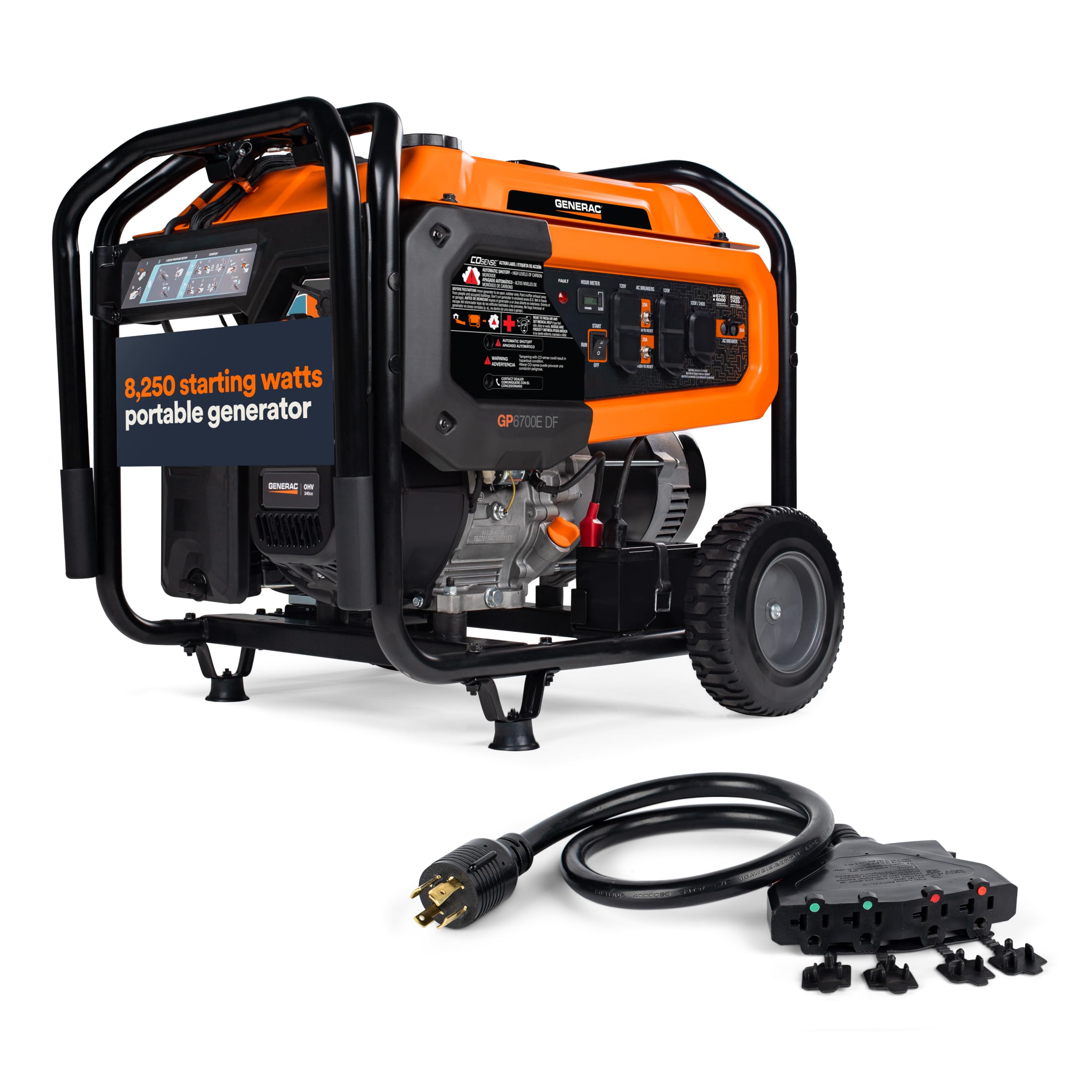



Last updated on 2026-09-16
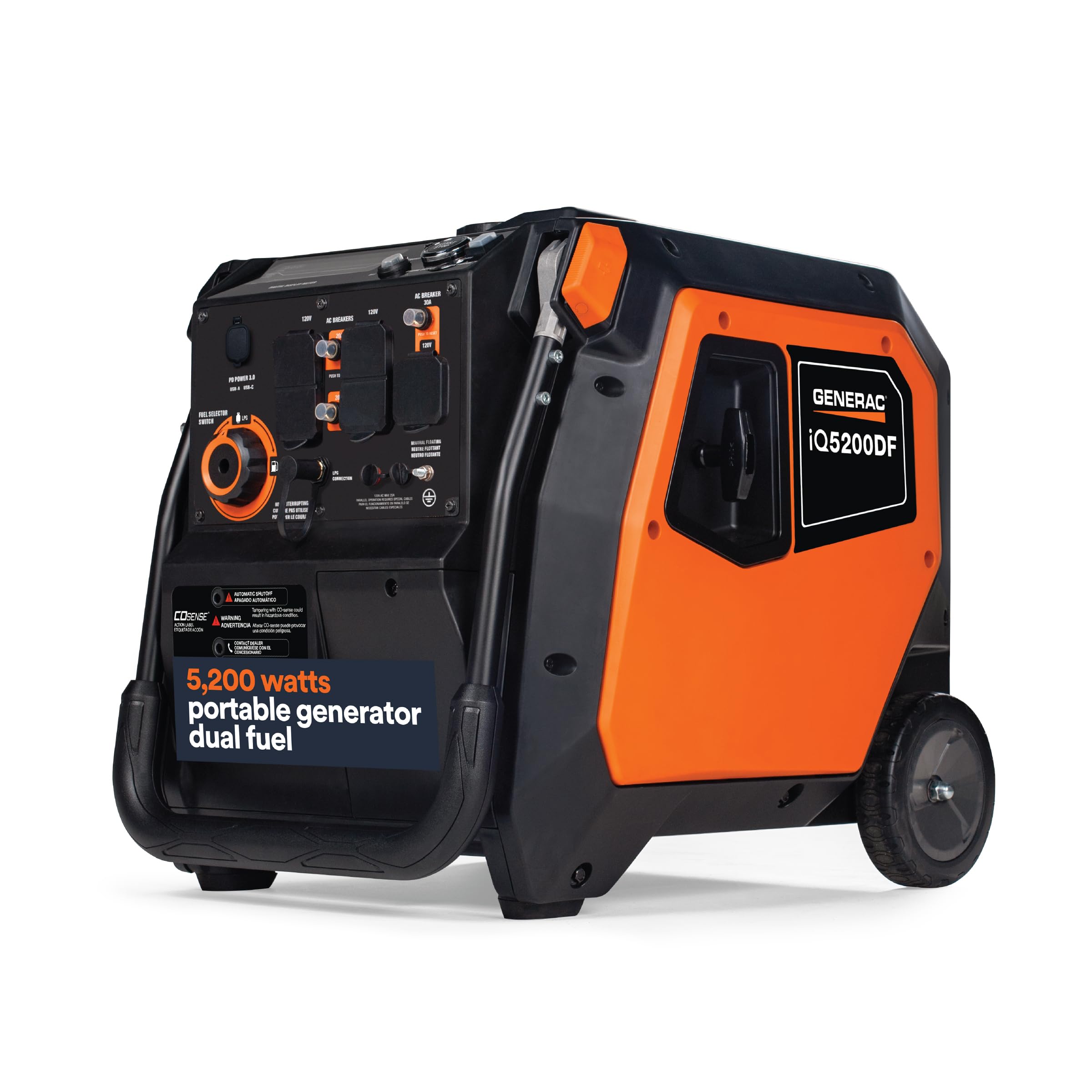
OUR TOP PICK
Choosing Your Size: Outage Bundle Scenarios
There is no single correct size for every buyer. The right size depends on your actual loads, your startup surge exposure, and how much bulk you’re willing to live with.
2,000W–2,500W
The MinimalistWeighs about 40–50 lbs; highly portable; usually uses a suitcase-style design; easy to store.
Limited startup margin and less tolerance for load overlap.
Some smaller inverter generators support parallel operation for higher output later.
Portable, essential-only backup.
- Refrigerator (intermittent)
- Router/modem
- 1 laptop
- 2 phones
- 4 LED light bulbs
3,500W–4,500W
The All-ArounderWeighs about 90–110 lbs; usually includes wheels and a telescoping handle for transport.
Bulkier, heavier, and less convenient to move or throw in a trunk.
Mixed household loads.
- Refrigerator
- Chest freezer
- 1/3 HP sump pump
- Mesh Wi‑Fi
- Television
- Several box fans
4,500W–5,000W
The High-OutputCan a 2,200W inverter generator run a refrigerator and sump pump?
Sometimes. Not always. That’s the only honest answer.
A 2,200W-class inverter generator may handle a refrigerator and a sump pump if startup surges don’t overlap badly, if the pump is modest, and if you’re disciplined about what else is plugged in. It may also disappoint you the first time the fridge compressor kicks on while the pump is already active.
Buyers often get into trouble with the smallest class. On paper, it can look adequate. In real life, storm conditions are messy, loads cycle unpredictably, and people always end up trying to power one more thing than they planned.
If a sump pump is mission-critical in your home, buying with extra margin is smarter than buying with hope.
Gasoline vs propane
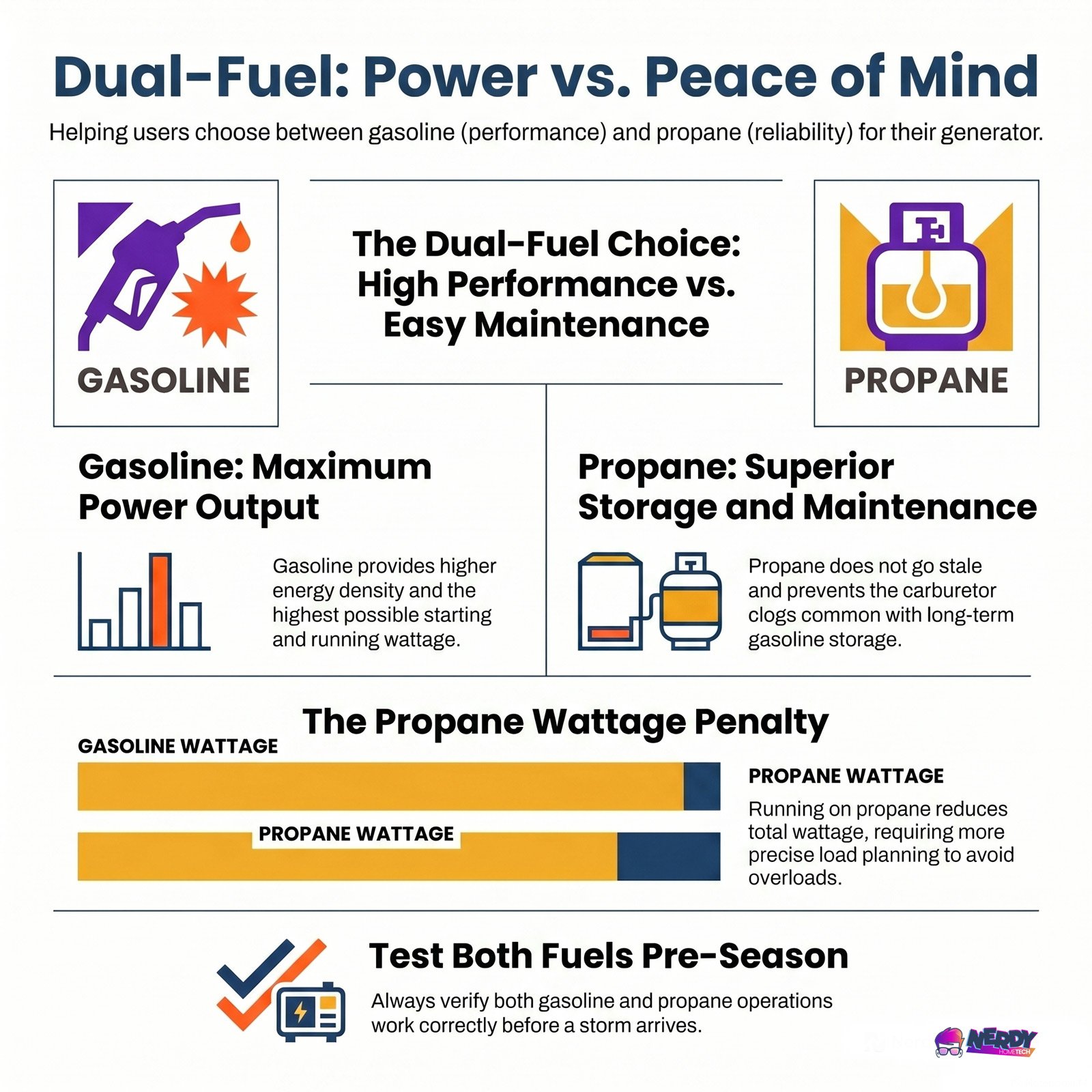
Gasoline usually gives you the strongest output from a generator. It has higher energy density and typically delivers slightly more wattage than propane.
Propane wins on storage convenience. It stores far better over time, doesn’t stale the way gasoline does, and can reduce the carburetor mess people create when they buy a generator, park it, and ignore it until a storm arrives.
The downside is reduced output. Running on propane usually trims available starting and running wattage enough that load planning becomes more important. That’s manageable if you’ve sized with margin, but becomes a problem when your load plan was already too optimistic.
If you buy a dual-fuel model, test both gasoline and propane operation before storm season rather than assuming both modes work correctly out of the box. If you know you won’t stay on top of fuel stabilization and carburetor care, propane may be the more realistic ownership choice even if gasoline offers stronger performance on paper.
Runtime: what buyers should and should not trust
Runtime figures are one of the easiest places for marketing to sound useful while telling you very little.
Manufacturers often quote runtime at 25% load because it produces a flattering number. That isn’t fake, but it also isn’t the same thing as telling you how long the generator will run when it’s supporting a refrigerator, a freezer, network gear, and a couple of fans during a real outage.
For actual buying decisions, think this way:
- lighter loads mean longer runtime and quieter operation
- higher sustained loads mean more fuel burn, more noise, and less runtime
- a generator that looks efficient at 25% load may feel much less impressive once you operate it in the 50% to 70% range that real outages often create
Published runtime figures are not enough by themselves.
Noise matters more than people admit
Noise affects whether you’ll actually keep the generator running when the outage drags on. But buyers should be careful here: a dB number taken under light load is not the whole story.
What matters in practice is not just whether a unit is “quiet” at idle or quarter-load. It’s how it behaves when your real outage load is cycling and the engine has to respond. Light-load dB claims don’t always predict real outage behavior. Don’t compare generators only by their lowest advertised noise number. Compare them by use case, expected load, and whether you actually need that extra output enough to justify the noise and bulk penalty.
A better backup strategy for some homes: generator plus battery
For some households, the smartest outage setup isn’t generator or battery. It’s both.
A battery power station provides silent, zero-emission power at the point of use. It works well indoors for overnight use, internet gear, small electronics, and some medical devices. A portable inverter generator works better for extended outages, refrigeration, and recharging that battery station during the day.
Some people should not be buying a generator as their only answer:
- apartment dwellers
- people with no safe outdoor operating space
- buyers who won’t maintain fuel equipment
- households that mainly need quiet overnight backup for low-draw essentials
For those users, a battery station may be the better primary solution, with a generator acting as a secondary recharge tool only if needed.
Model selection criteria
The picks below are meant to cover four common storm-backup use cases. Before buying, verify current specs, outlet mix, CO-safety features, warranty terms, and local service options to ensure the unit fits your specific needs.
Recommended models basic rundown
| Model | Starting / Running Watts | Claimed Runtime (25% Load) | Best For |
|---|---|---|---|
| Honda EU2200i | 2,200 / 1,800 | ~8.1 hours | Disciplined small-load backup; premium reliability |
| Champion 2500-Watt | 2,500 / 1,850 | ~11.5 hours | Lightweight dual-fuel flexibility |
| Westinghouse iGen5000DF | 5,000 / 3,700 | ~18 hours | Stronger surge handling and comfort loads |
| WEN 56235IX | 2,350 / 1,800 | ~9.4 hours | Basic, no-frills emergency backup |
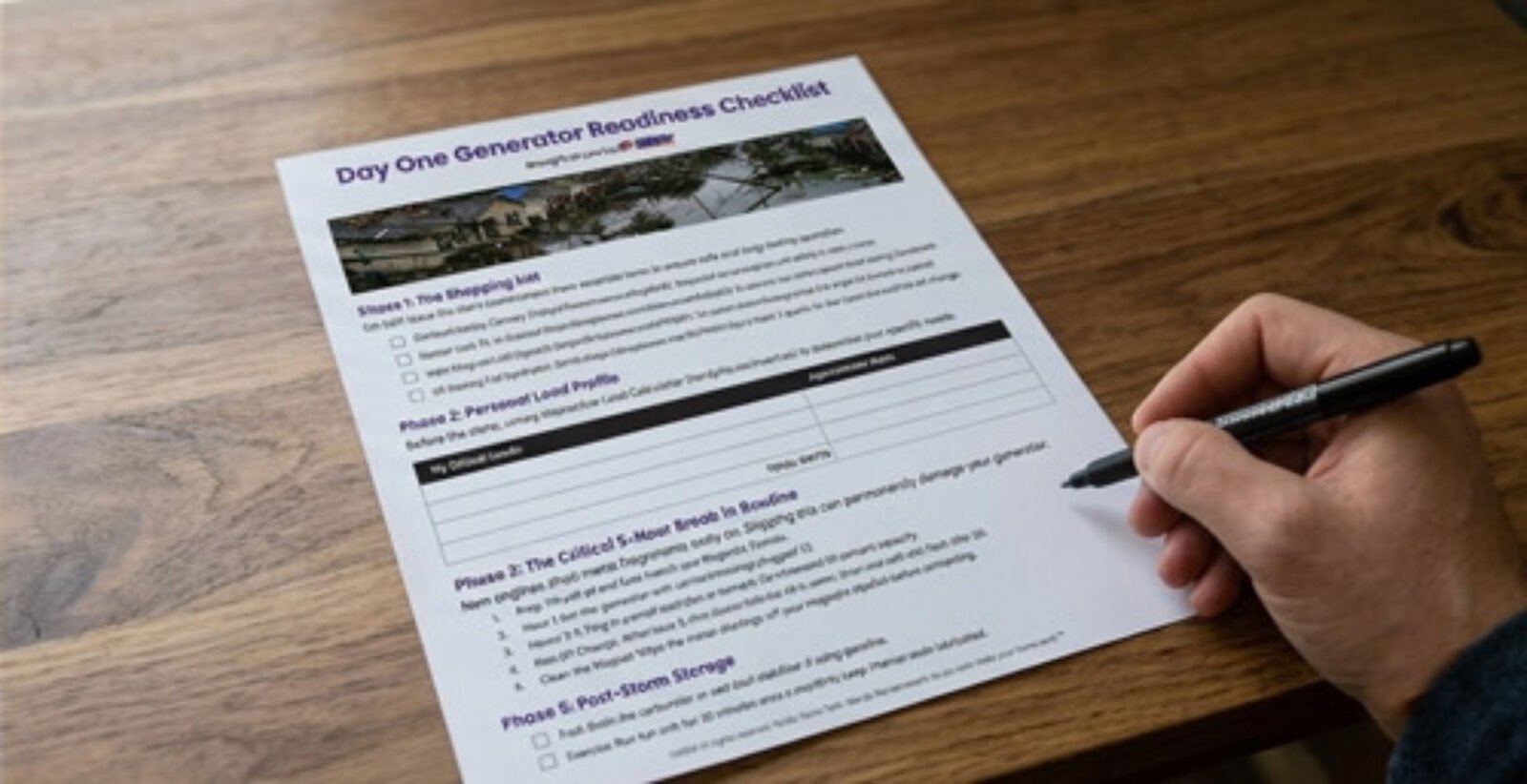
FREE DOWNLOAD
Download this FREE Day One Generator Readiness Checklist to get a printable, step-by-step roadmap for essential safety gear and the critical five-hour engine break-in routine.How to choose between these four picks
- Choose the Honda if your loads are light and you care most about portability, low noise, and long-term ownership confidence.
- Choose the Champion if you want dual-fuel flexibility in a lighter package and can live with tighter output on propane.
- Choose the Westinghouse if you need more startup headroom and want a more realistic comfort backup setup.
- Choose the WEN if your outage plan is simple and you’re deliberately keeping expectations modest.
Westinghouse iGen5000DF
NERDY’S OVERALL PICK
This model is designed for homeowners needing more temporary outage coverage, stronger surge handling, and more comfort-load flexibility. It includes an RV-ready TT-30R outlet and a digital display for monitoring output and runtime information.
At over 100 pounds, it requires level ground and the use of its included wheels for mobility. It offers better real-world margin, but is much bulkier to move or store.
READ OUR FULL BUYER’S GUIDE >

Honda EU2200i
Honda’s appeal is straightforward: low noise, compact size, strong owner trust, and strong resale strength.
It is great for disciplined small-load backup, though it is easier to outgrow if your outage plan keeps expanding, and it lacks a dual-fuel option.

Champion 2500-Watt Dual-Fuel
Champion is widely available and commonly considered easier to source than many smaller brands. Weighing just 39 pounds, this is among the lightest dual-fuel inverters available.
However, on propane, running watts drop to 1,665W, requiring careful load management during compressor startups. You need to size with honesty, not optimism.

WEN56235IX
WEN can make sense for simpler backup needs, but buyers who prioritize long-term support and service convenience may prefer a more established premium brand.
It’s positioned as a straightforward, no-frills backup option for basic emergency power needs. It is a less forgiving choice if you expect long-term heavy use or support depth.

What the spec sheet still doesn’t tell you
Even a decent comparison table doesn’t answer everything.
Before buying, pay closer attention to:
- whether the model includes a CO shutoff system and how much you trust that feature as a backup layer rather than an excuse for bad placement
- how heavy the unit is once fuel is in it, not just the dry number you glanced at online
- whether the outlet mix matches how you actually plan to use it
- whether the unit supports parallel operation if you want a small-generator-first strategy
- whether the maintenance burden fits your habits, not your intentions
A lot of buyers shop like optimists. Generator ownership punishes optimists.
Transfer switch vs interlock vs extension cords
Extension cords are usually the lowest-cost and lowest-friction route for occasional outages. Interlocks and transfer switches are cleaner and more convenient long term, but they add electrician cost, planning, and code-compliance complexity. If you only need a few portable loads, extension cords are often the more rational choice.
Interlock kit vs transfer switch: which is smarter for occasional outages?
An interlock is often the cleaner middle ground if you want panel access without a more structured transfer-switch setup. Because most small inverters are 120V-only, your electrician will need to determine the correct code-compliant way to supply selected 120V circuits from the panel.
Transfer switches are cleaner for a fixed set of critical circuits, giving you a more structured backup workflow. Meanwhile, extension cords are still the low-friction answer for many occasional-outage users who want the lowest setup cost and no electrical work.
Generator extension cord sizing by distance and load
Vague advice about “use a heavy cord” is useless, so here’s the practical version.
- For lighter loads over shorter distances, a 12-gauge outdoor-rated cord is often the sensible minimum
- As load increases or cord length gets longer, moving to 10-gauge can reduce voltage drop and heat buildup
- The more current you’re asking the cord to carry, the less room you have for cheap shortcuts
A short run to a single refrigerator is different from a long run feeding multiple devices through a splitter; as length and load rise together, heavier-gauge cable becomes the safer choice. Cheap, thin cords are one of the dumbest weak links in otherwise decent outage setups.
Cold weather, storage, and altitude matter
Storm outages don’t happen only in mild weather with ideal fuel and perfect startup conditions.
Cold weather can make starting harder, especially if maintenance is sloppy or fuel quality is poor. Long-term storage can create fuel problems if gasoline isn’t treated and cycled properly. If you live at higher elevation, reduced engine output can matter enough that a generator sized too tightly at sea level may no longer feel adequate in real use.
You shouldn’t build an outage plan around best-case assumptions and then act surprised when bad weather shows up and the machine behaves differently than it did on a calm day in the driveway.
Maintenance and ownership friction
A generator you never test is not backup equipment. It’s a false sense of preparedness.
If you buy one, you need to:
- follow the break-in process (the initial break-in oil change is manufacturer-specific, but often recommended after just 5 hours of use)
- perform oil changes on schedule
- manage fuel properly
- run the unit under load periodically
- verify that the loads you plan to run are actually handled the way you expect
Propane has strong appeal for some buyers because gasoline punishes neglect faster. If you know your habits are weak, choose around your real behavior, not your ideal self.
CO safety features and what they do not replace
CO shutoff systems are useful. They are not permission to get stupid.
If a generator includes carbon monoxide shutdown technology, that is a worthwhile safety feature. But it is still a backup layer, not the core safety plan. Proper placement outdoors and away from openings matters more than any marketing badge on the box.
In other words, treat CO safety features as one factor in the purchase decision, not as an excuse to relax your operating standards.
Operational practicalities
A generator can be technically good and still be a lousy fit for your life if you ignore the practical side.
- Placement: A strong starting point is keeping the unit well away from the home, with the exhaust pointed away from doors, windows, and vents, while following the manufacturer’s clearance instructions. Never run a generator in a garage, even with the door open.
- Weather protection: Water and electricity are hazardous. Only use a cover specifically designed for generator operation, and make sure it protects the electrical panel without restricting engine ventilation or cooling.
- Refueling: Always shut the generator down and let it cool before refueling. Store gasoline and propane only in approved containers and cylinders, away from living spaces and ignition sources.
- Security: Generators are high-theft items during blackouts. Use a heavy-duty locking cable to secure the unit to a heavy anchor.
- Testing: Don’t wait until the next storm warning to discover stale fuel, a dead battery, or a machine that won’t carry the loads you assumed it could.
What smart buyers get right
A portable inverter generator is one of the most practical tools for storm-season outage backup if you stay honest about what it can and cannot do. It can turn a multiday blackout from a crisis into a far more manageable inconvenience. It’s for temporary support of critical loads. It is not a magic substitute for a larger backup architecture.
Buy for your real loads, leave yourself margin for startup surges, choose the fuel strategy that matches your actual ownership habits, and don’t build your backup plan around fantasy scenarios. The worst time to discover you bought the wrong generator is when the food is warming up, the sump pump is cycling, and the lights are already out.
The “Forgotten” Kit: 4 Items Most Buyers Overlook
Most people leave the store feeling prepared once they have the box in their cart and a gas can in their hand. But owning a generator is only half the battle; operating it in a real-world storm is the other. We see a common pattern where first-time owners overlook the small accessories that mean the difference between a smooth backup plan and a frustrated trip back to the store in the rain.
The Weather Shield:
You bought this for a storm, yet you can’t run it in the rain without risking a short circuit or worse. A dedicated safety canopy, like the GenTent, is the only way to keep your power flowing safely when the weather is actually at its worst. It protects the electrical panel while still letting the engine breathe.
The Theft Deterrent:
During a blackout, your generator is the most valuable thing on your block. Don’t make it easy to steal. A heavy-duty anchor, such as the Master Lock 72-in Braided Steel Cable, allows you to secure the unit to a permanent fixture. It’s your only real defense against opportunistic “drive-by” theft while the neighborhood is dark.
The Engine Lifesaver:
Small inverter engines shed tiny metal “glitter” during their first few days of work. A magnetic tool like the WEN Magnetic Oil Dipstick catches these shavings before they can grind down your engine’s internals. It’s cheap insurance for a machine you’re relying on for survival.
The Maintenance Basics:
You will need to change the oil much sooner than you think (often after the first 5 hours). Pick up a few quarts of VP Racing Full Synthetic 10W-30 now. Trying to pour oil into a tiny, recessed hole at 2:00 AM is a recipe for a mess, so don’t forget a long-neck funnel to make the job painless.