
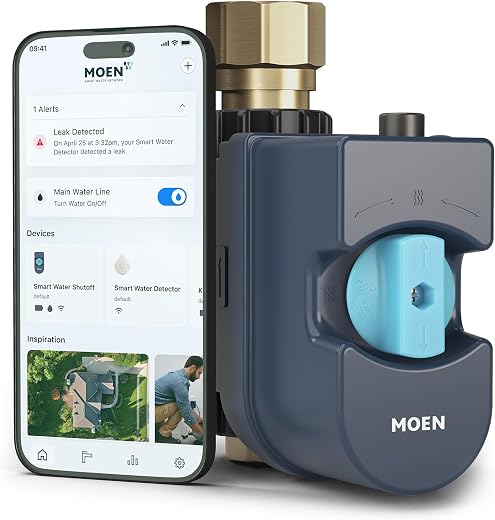
Moen Flo Smart Water Monitor and Automatic Shutoff Sensor
 Amazon.com
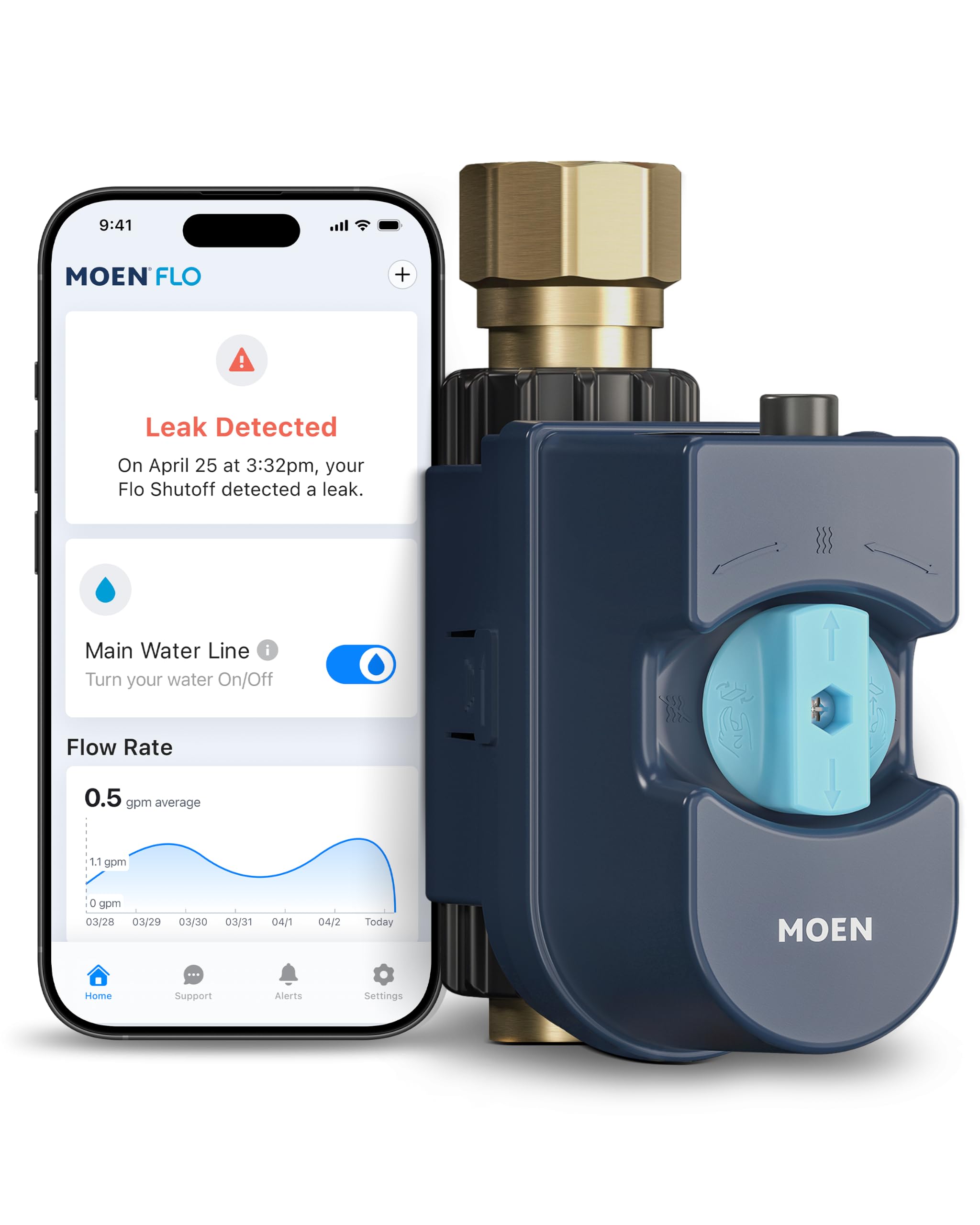
 Protect your home from costly water damage with this smart water leak detector. It learns your home’s water usage to spot issues like running water or small leaks and can automatically shut off water to prevent damage. Get real-time alerts via app, phone, or email, whether you’re home or away. Control your water anytime with the Smart Water App, and FloSense technology customizes protection while saving water. Easy to install (1-Inch to 1-1/4-Inch pipes) and works with Alexa, Google Assistant, and Control4.
Complex Plumbing Setups That Need Extra Scrutiny
Some houses are simple. Others are exactly where a smart shutoff valve becomes more trouble than the marketing suggests.
Irrigation systems
Long irrigation runs, seasonal sprinkler startup, and unusually high outdoor flow can trigger nuisance shutoffs. Moen has treated irrigation as enough of a real-world problem that it integrated Flo behavior with its smart sprinkler products to reduce mistaken shutoffs during watering events. Homes with heavy irrigation demand should assume more setup friction and more early false alarms than a basic indoor-only plumbing system.
Hot water recirculation loops
Moen says the Flo is compatible with hot water recirculation pumps, but “compatible” is doing a lot of work there. Should the Flo automatically shut off the home’s water supply, Moen recommends turning off the recirculation pump to avoid unnecessary wear on the loop, and also recommends shutting down the water heater or boiler in that event. That is not a deal-breaker, but it represents the exact kind of operational detail buyers need before spending money.
Booster pumps, detached structures, and odd plumbing layouts
Houses with pressure boosters, long branch runs, detached buildings, or multiple plumbing zones off one main introduce tougher troubleshooting scenarios. The Flo may still work, but this stops being an “install gadget, open app, done” project and starts becoming an actual plumbing-system design question.
How Moen Flo Detects Leaks
Nightly micro-leak tests
Moen advertises that Flo can detect leaks down to very small drip levels. This is not continuous magic. It relies on an automated nightly health test rather than constant real-time micro-leak sensing.
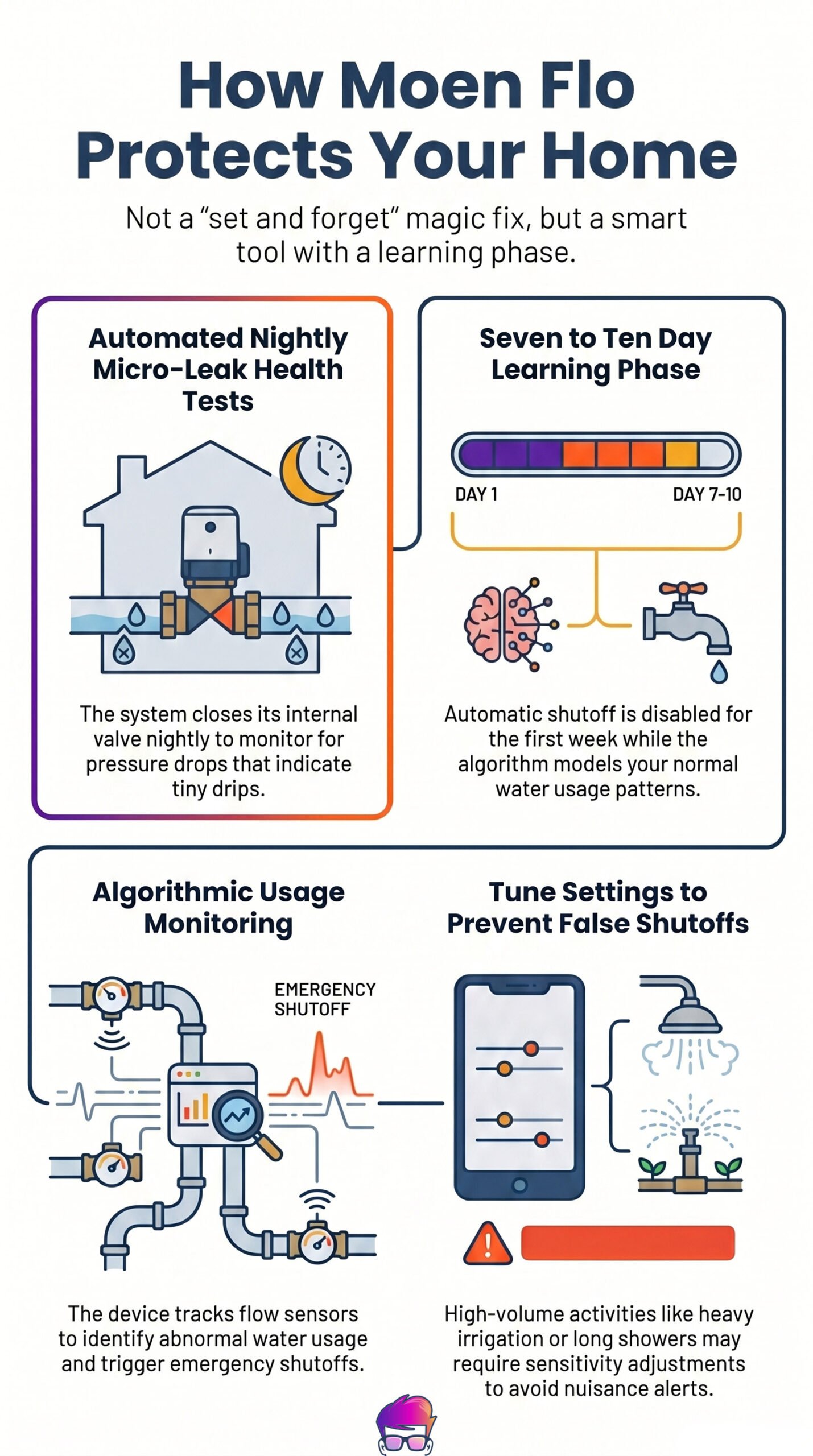
At night, the Flo closes its internal valve to isolate your home from the municipal supply, then monitors for pressure drops over a 30-second to 4-minute window. A steady pressure reading means your system is tight. A slow drop flags a possible micro-leak.
That is a clever application of basic physics, but it is not flawless. Thermal expansion from a water heater, a borderline PRV, or behavior in an expansion tank can all create pressure changes that look suspicious even when there is no actual leak. You still have to understand your house well enough to separate a real warning from plumbing noise.
Algorithmic learning and false shutoffs
For larger leaks, the Flo relies on flow sensors and an algorithm that learns your normal water usage. When first installed, it enters a 7- to 10-day learning phase to model your household’s patterns. Automatic shutoff is disabled during that period. Catastrophic events during this learning mode trigger alerts, but not automatic protection.
After the learning period, the system can shut off water when usage looks abnormal. Long showers, heavy irrigation, filling a tub, or other sustained flows can still trigger nuisance shutoffs until you tune the device’s sensitivity and operating modes. Households with irregular water habits should expect setup friction rather than instant perfection.
Moen Flo Problems and Failure Modes
This is the part the product page minimizes. These are the issues that matter after installation, when you have to live with the device.
Turbine wear and silent failure
The Flo measures flow using an inline mechanical turbine. Water spins a small wheel, magnets encode the speed, and the electronics calculate flow from that movement.
That design has a prominent weakness: the turbine sits directly in the water stream. In hard-water or sediment-heavy environments, mineral scale and debris can build up on the wheel and magnets, eventually skewing readings or jamming the mechanism. The worst-case result is a silent failure: water is moving, but the device reports little or no usage.
Moen has acknowledged turbine-related problems enough to publish repair guidance and support upgrade or replacement paths. Servicing the turbine means opening up the valve assembly on your main line. Most homeowners are not going to enjoy that job.
False alarms and sensitivity tuning
By design, Flo errs on the side of interruption. That is the whole point of an automatic shutoff valve. The cost is that legitimate heavy usage can look suspicious enough to trigger an alert or shutdown.
Households routinely running long continuous flows, seasonal irrigation, or unusual high-demand usage will spend time tuning modes and sensitivity. This is not a one-click appliance in every home.
Cloud dependence and service outages
The Flo can execute shutoff behavior locally based on its sensors and internal logic, but app access, notifications, and data history depend heavily on Moen’s cloud services.
- A dropped home internet connection severs remote access, push alerts, and live app visibility until connectivity returns.
- Moen’s cloud or app backend experiencing a bad day will cause similar symptoms even when your own network is fine.
- Disliking the idea of cutting a cloud-tied valve into your main line and depending on long-term vendor support is a perfectly rational concern.
This is not unique to Moen. It is simply the tradeoff you accept with a cloud-managed shutoff system.
Long-Term Ownership and Serviceability
This is not automatically a “set it and forget it” device. In houses with hard water or dirty water, the turbine is effectively a maintenance-exposed component.
Moen has published turbine repair guidance and supported upgrade or replacement paths, which means owners should take the issue seriously. The problem is predictability: Moen does not give homeowners a neat service interval like “clean or replace this every 5 years.” Consequently, you end up managing by symptoms—bad readings, strange flow behavior, missed usage, or a stuck turbine—instead of following a clean preventive schedule.
That matters because it changes the ownership experience. Flo buyers should expect to eventually deal with upstream filtration, water-quality troubleshooting, or turbine service over the life of the valve. Homeowners who hate service uncertainty and want a design with fewer moving flow-sensor parts should lean toward the Phyn Plus instead.
Offline Behavior and Power Loss
Wi-Fi and internet outages A router reboot or ISP drop leaves the Flo with its local protection logic intact. Spotting a flow profile that looks like a burst pipe still triggers the valve automatically without cloud access. What you lose is visibility and control: no push alerts, no live data, and no remote valve control until connectivity returns.
Power outages The base unit has no internal battery. It needs a 100–240 V AC outlet near the install location. A power loss leaves the valve locked in its last position and halts monitoring.
Moen sells a dedicated Battery Backup kit (Model 920-008) providing roughly four hours of runtime. It is clearly intended for short outages, not multi-day events. With pricing sitting between $340 and $530 depending on the distributor, this is not a trivial accessory purchase. Regions prone to long blackouts will find the battery backup softens the problem but does not solve it.
Manual override: what that actually means App unavailability means using Moen’s supplied hex key tool to physically operate the valve. The tool must be inserted into the valve control, pressed fully down, and turned a quarter turn to open or close the water supply. On smaller units, that tool is 5/16-inch; on the 1¼-inch unit, it is 3/8-inch. Losing that tool while the valve is closed during a blackout means you are not casually restoring water with your fingers. Keep the tool somewhere obvious and permanent.
Real-World Costs and Subscriptions
The hardware price is only the starting point.
Hardware, installation, and battery backup
- Professional installation ($200–$1,000+) Unless you are comfortable shutting off the main, cutting copper or PEX, and making clean plumbing connections in a tight space, you will need a plumber. Clearances requiring manifold rebuilds will push this price toward the top of that spectrum.
- Battery backup (roughly $340–$530) The 920-008 backup kit is optional on paper but close to mandatory for those expecting protection during short outages who do not want the system going blind the moment power drops.
FloProtect: warranty and deductible coverage
FloProtect is Moen’s optional subscription tier. For $5 per month, it extends the limited warranty to five years from activation and offers up to $5,000 in deductible reimbursement for qualifying catastrophic water damage events.
That reimbursement is strictly conditional. The terms require that the device was properly installed, actively subscribed, online, correctly configured, and not sitting in its initial learning mode when the event happened. FloProtect is a warranty-style protection program with explicit rules and exclusions, not blanket water-damage insurance.
Crucially, it is not a free pass for neglected plumbing. Damage traced back to long-standing deterioration, deferred maintenance, corrosion, or pre-existing conditions yields much less sympathy than homeowners imagine.
Consumers who care about this coverage must read the current FloProtect terms and privacy policy directly. That is the only intelligent way to judge whether the program is worth the monthly fee. Additionally, call your homeowner’s insurer before buying; some carriers offer discounts for automatic shutoff devices that can offset part of the upfront cost.
Smart Home and Home Assistant Integration
For mainstream smart home systems, Flo integrates natively with Amazon Alexa, Google Home, Control4, Ring, NICE, and Alarm.com. That provides status visibility, notifications, and remote shutoff control within supported platforms.
For Home Assistant users, the main caveat remains the same: this is cloud-dependent, not truly local. You can expose sensors and control entities, but the experience depends on Moen’s service being up and your internet connection being stable.
More importantly, cloud polling means delay. In practical terms, a polled cloud API updates on an interval measured in minutes rather than seconds. That works fine for dashboards and historical data, but it is a terrible mechanism for acute emergency automations. A multi-minute polling delay during a massive pipe failure means hundreds of gallons of water hitting your floor before Home Assistant even reflects the event. Use the Flo’s built-in shutoff logic as the emergency mechanism, not a cloud-polled Home Assistant automation.
Moen Flo vs Phyn Plus vs Flume 2
The Flo is not your only option. The two obvious alternatives are the Phyn Plus and Flume 2, but they solve the problem in very different ways.
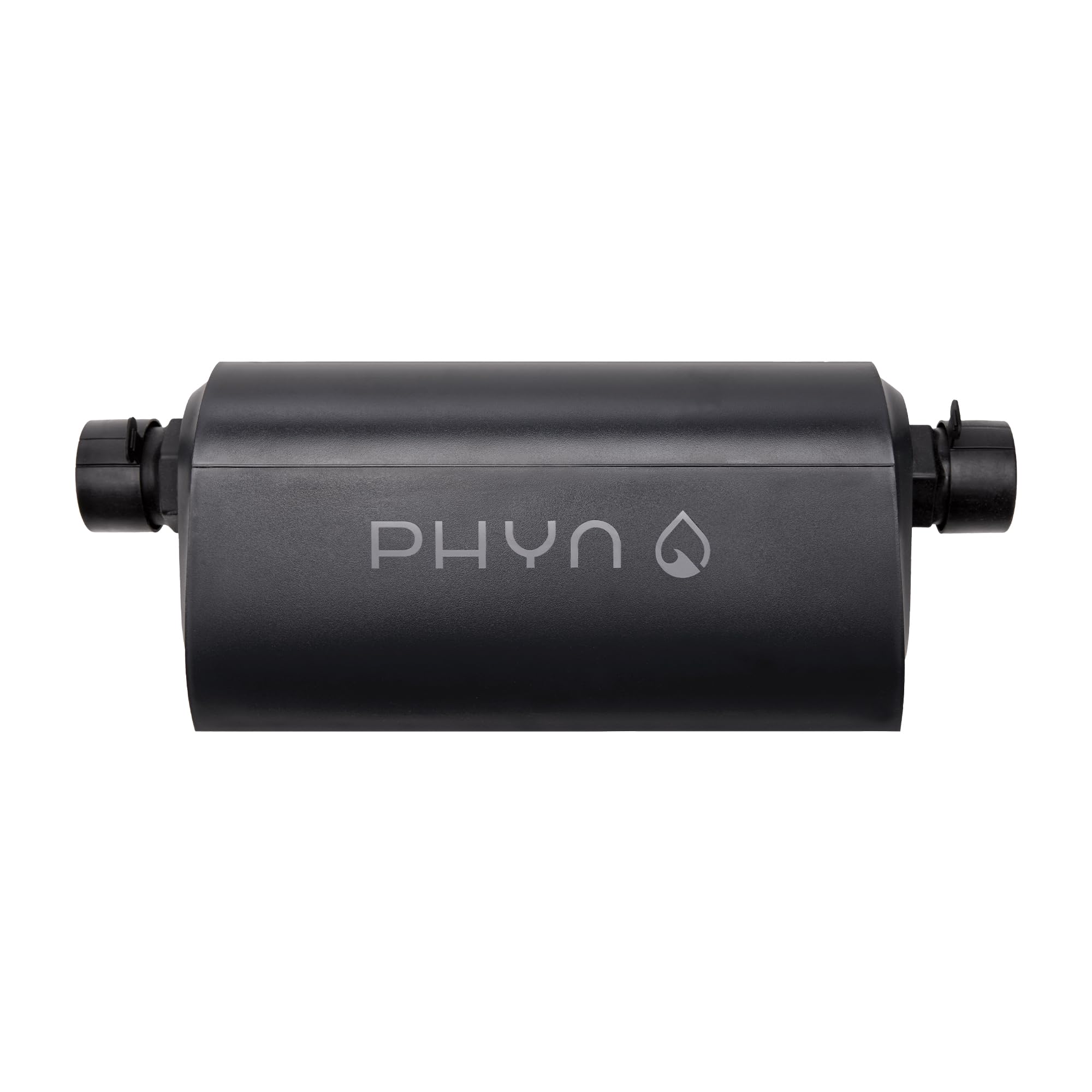
Phyn Plus uses an ultrasonic flow sensor and pressure-wave analysis, featuring no moving parts in the water stream. That design is inherently less exposed to scale buildup and debris-related sensor wear than a turbine-based device.
Flume 2 straps onto your existing utility meter and reads the meter externally. It never touches your household plumbing and does not offer automatic shutoff. It is easier to install and less invasive, but it cannot physically stop a leak.
Flume also has two critical hardware constraints people skip over. First, it is not compatible with every water meter. Flume claims compatibility with about 95% of U.S. meters, but buying a Flume first and checking compatibility later is a costly mistake.
Second, the Flume straps to the outside of the meter using heavy-duty rubber bands. In regions with extreme heat or freezing winters, those bands can dry rot, snap, and drop the sensor into the mud. It is a cheap fix, but a known physical failure mode.


Last updated on 2026-09-29
Feature summary
| Feature | Moen Flo Smart Water Shutoff | Phyn Plus (2nd Gen) | Flume 2 Smart Water Monitor |
|---|---|---|---|
| Detection method | Inline mechanical turbine + pressure | Ultrasonic + pressure-wave analysis, no moving parts | External meter reading |
| Automatic shutoff | Yes | Yes | No |
| Installation | Plumber strongly recommended | Plumber strongly recommended | DIY (Verify meter compatibility first) |
| Physical Risk | High (Scale and debris foul the turbine) | Low | Medium (Rubber mounting bands can dry rot) |
| Power source | Hardwired AC; optional battery backup | Hardwired AC | Battery powered, typically 1–2 years |
Frequently Asked Questions (FAQ)
Does the Moen Flo require a subscription?
No. Core functions such as shutoff, alerts, and basic monitoring are available without a subscription. FloProtect is an optional $5/month tier adding extended warranty coverage and deductible reimbursement under strictly governed conditions.
Can Moen Flo be installed outside?
Yes, but with caveats. The device is weather-resistant, not indestructible. Installers strongly recommend a protective enclosure, above-grade placement, reliable 2.4 GHz Wi-Fi coverage, and weather-safe power access.
What happens in a power outage?
Without the optional battery backup, the device loses power immediately, monitoring stops, and the valve remains stuck in its last open or closed state. Installing the battery kit provides roughly four hours of extra runtime.
Will Moen Flo reduce water pressure?
Purchasing the correct size for your main line ensures the Flo will not create a meaningful pressure drop in normal residential use. However, houses with already borderline pressure or undersized piping will not see any improvements.
Does Flume 2 work on every water meter?
No. Flume works with most U.S. meters, but not all of them. Buyers must verify meter compatibility before purchasing, otherwise the device may be useless upon arrival.
Which Flo configuration makes sense?
Treating every Moen Flo listing as interchangeable is a mistake. The crucial variables are valve size and whether you need the battery backup.
- Purchase the ¾-inch model only if your main service line is exactly ¾ inch.
- Purchase the 1-inch model if your main is 1 inch, which is common in newer or larger homes.
- Purchase the 1¼-inch model only if a plumber confirms that specific size at the main.
- Skip the battery backup only if short outages are exceptionally rare in your area and you are comfortable losing all monitoring the second the grid goes down.
Next Steps: Check Your Plumbing
Now that you know the technical realities and physical constraints of the Moen Flo, it is time to evaluate your own home. Before buying anything, head down to your basement or utility closet. Locate your main shutoff valve and physically measure the diameter of the pipe. Check the surrounding clearance to see if a plumber actually has room to work, and verify you have a standard AC outlet within 10 feet.
Once you confirm your infrastructure can support it, you can select the correct hardware bundle for your home below.
Moen Flo Smart Water Monitor and Automatic Shutoff Sensor
Features
| Number of Batteries | 1 AA batteries required. |
| Control Method | Voice |
| Manufacturer | Moen Incorporated |
| Part Number | 900-006 |
| Item Weight | 5.61 pounds |
| Product Dimensions | 4.46 x 2.6 x 5.9 inches |
| Country of Origin | Taiwan |
| Item model number | 900-006 |
| Batteries | 1 AA batteries required. |
| Size | 1 Inch |
| Style | Smart Water Shutoff |
| Finish | Unfinished |
| Material | Brass, Plastic |
| Item Package Quantity | 1 |
| Number Of Pieces | 1 |
| Usage | Indoor/Outdoor |
| Included Components | Power Adapter, Leak Detection System, Threaded tailpieces, O-rings, Spacers |
| Batteries Included | No |
| Batteries Required | No |
| Battery Cell Type | Alkaline |
| Warranty Description | 1-Year Warranty |
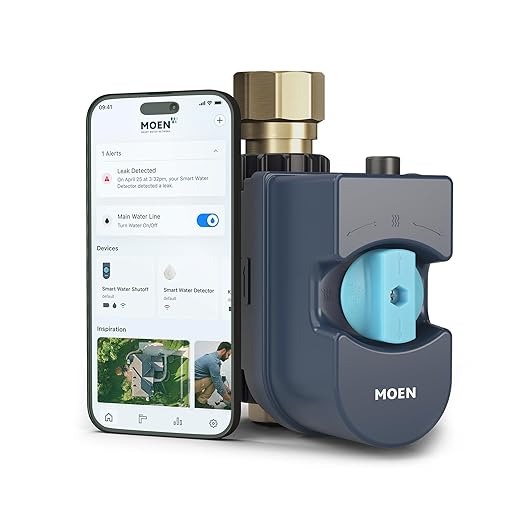
Protect your home from costly water damage with this smart water leak detector. It learns your home’s water usage to spot issues like running water or small leaks and can automatically shut off water to prevent damage. Get real-time alerts via app, phone, or email, whether you’re home or away. Control your water anytime with the Smart Water App, and FloSense technology customizes protection while saving water. Easy to install (1-Inch to 1-1/4-Inch pipes) and works with Alexa, Google Assistant, and Control4.