Aeocky sent us this unit at no cost. That didn’t change how we tested it or what we found.
Aeocky RHEA-001 Dehumidifier: We Tested the 80-Pint Claim in a Real Garage. Here’s What It Actually Did.
A damp basement. A musty garage. Windows that fog up and stay that way. Too much humidity is the kind of household problem that’s easy to ignore right up until it turns into mold, allergies, or a room nobody wants to sit in.
A good dehumidifier fixes all of that. The hard part is figuring out which one actually does what the box says.
Aeocky makes several dehumidifier lines, from compact units for a bedroom or a car up to big-capacity models built for basements and garages. The Aeocky RHEA-001 sits near the top of that range. It’s marketed as an 80-pint-per-day machine covering 5,500 square feet — and we spent two days in September 2026 finding out what those numbers actually mean when you plug one in.
Short version: it works. But almost none of the headline numbers mean what you’d assume, and the most important one isn’t on the box at all.
| Preview | Product | Rating | |
|---|---|---|---|
 | AEOCKY 5500 Sq.Ft Energy Star Most Efficient 2025 Dehumidifier Max 80Pint/D White 80 pints… | CHECK PRICE |
Last updated on 2026-09-10
How We Tested It
We ran the RHEA-001 in a standard one-car garage. Not by choice, exactly — basements aren’t really a thing in South Florida. The space is insulated but has no air conditioning, and every test ran with the door shut and nobody moving around inside.
Worth knowing up front: Aeocky’s manual recommends using this unit in a relatively enclosed space, and warns that a steady inflow of outside air will keep it from pulling humidity down effectively. An insulated garage isn’t a sealed basement. It’s a bigger, warmer, less controlled box of air. That context matters for a couple of the numbers below, and we’ll flag where.
Here’s what we used:
Humidity:
A dedicated sensor rated to ±1.8% relative humidity, sanity-checked against outdoor conditions before testing began. We logged the dehumidifier’s own panel reading alongside it every time.
Power:
A plug-in meter running to the unit alone, nothing else sharing the outlet.
Water:
A digital scale, weighing the tank before and after each run, converted at roughly 1.04 pounds per pint.
Noise:
A decibel meter at three feet, with the garage fans switched off so we were measuring the dehumidifier and nothing else.
Exhaust heat:
A thermometer at the air outlet.
Aeocky also says it was the No.1 best-selling dehumidifier brand on Amazon in the U.S. for 2025, citing third-party retail data in its own press materials. We haven’t verified that independently, but it explains why this model turns up in so many search results.
About That 80-Pint Number
This is where most of the confusion around this unit lives, so let’s clear it up first.
Quick background: ENERGY STAR is an EPA certification meaning a product hits a baseline of energy efficiency. “ENERGY STAR Most Efficient” is a narrower tier above that, for products that go past the standard requirements. It’s a real distinction, and the RHEA-001 genuinely holds it — we confirmed that in the government’s own database.
Now the pints. Aeocky publishes two figures for this unit: 80 pints per day at 95°F and 95% humidity, and 56 pints per day at 86°F and 80% humidity. That first condition is a saturation test. Think sauna, not basement. It’s also the number that ends up in the product title.
Meanwhile, the unit’s actual ENERGY STAR certification lists water removal at 24.5 pints per day under the standard test condition.
Same machine. Three numbers. Three different tests.
None of that makes 80 pints a lie. It’s a real measurement under a real (if extreme) condition. The problem is that it’s presented as the number with no test condition anywhere near it, so a shopper has no way to know that 80 and 24.5 are both true.
The Smart Drying Mode Test
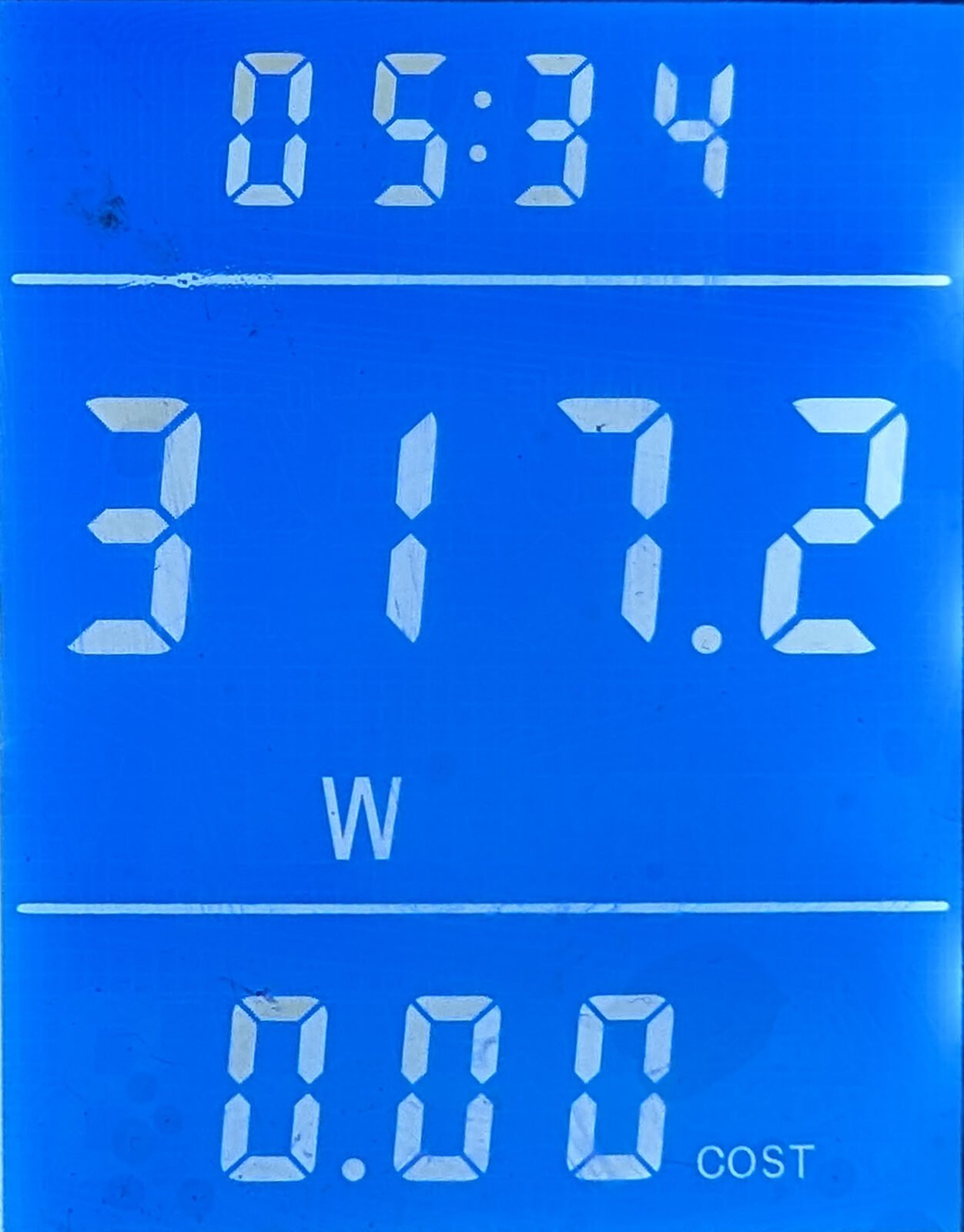
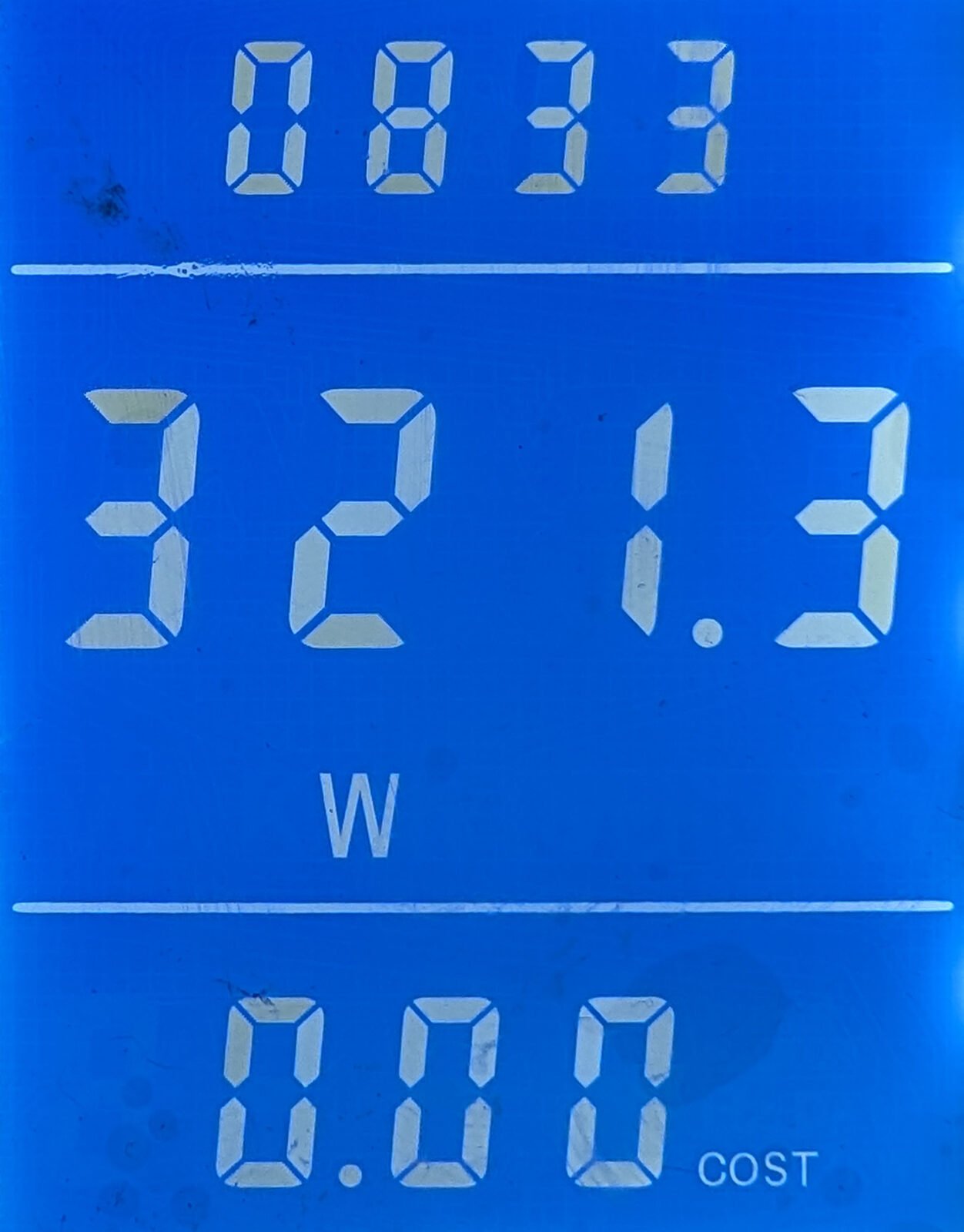
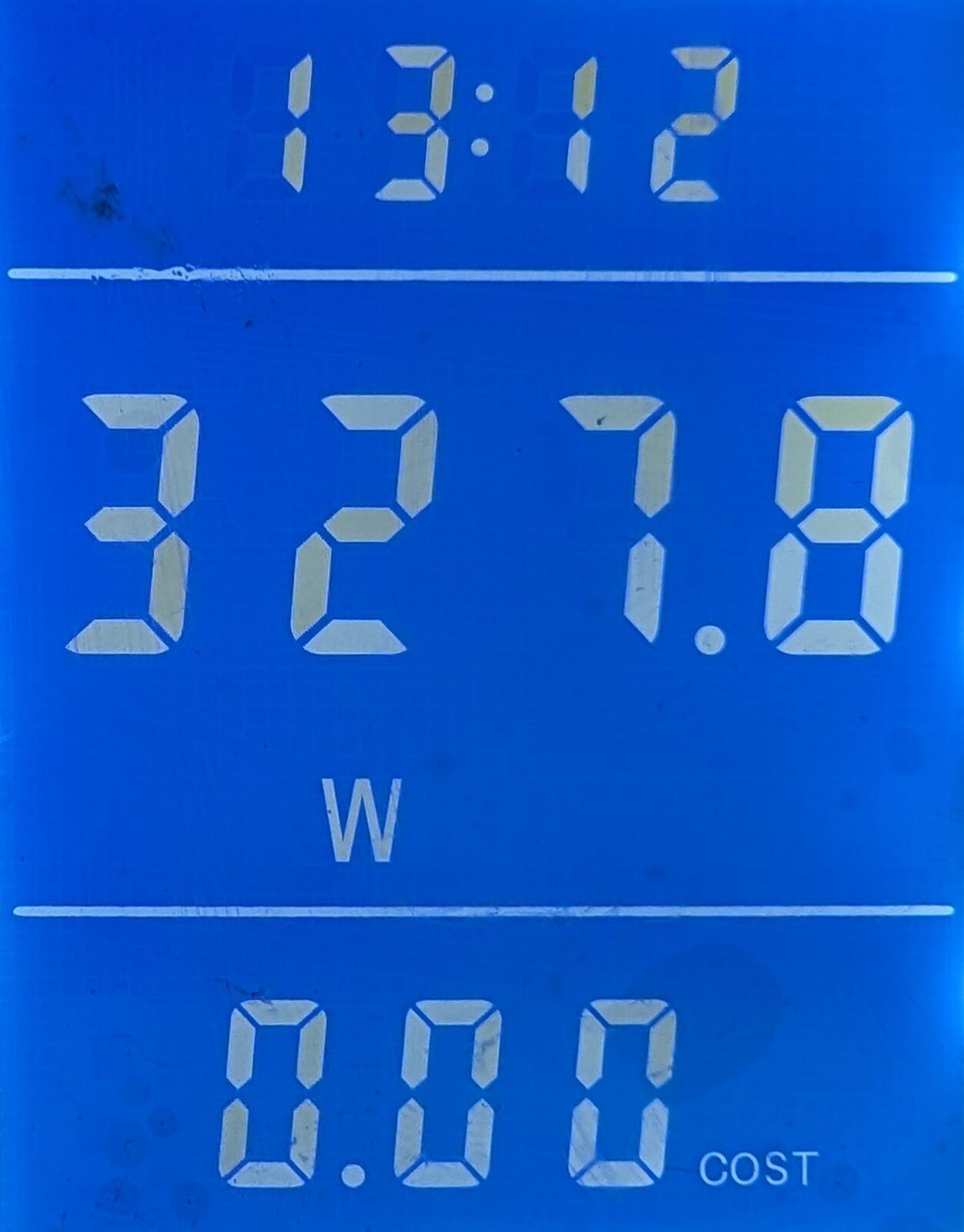
Smart Drying is probably the mode most people will leave it on, so we gave it a dedicated 20-minute run — unit fully unplugged and reset first, readings timestamped every few minutes, with photos of the panel, the meter, and the hygrometer throughout.
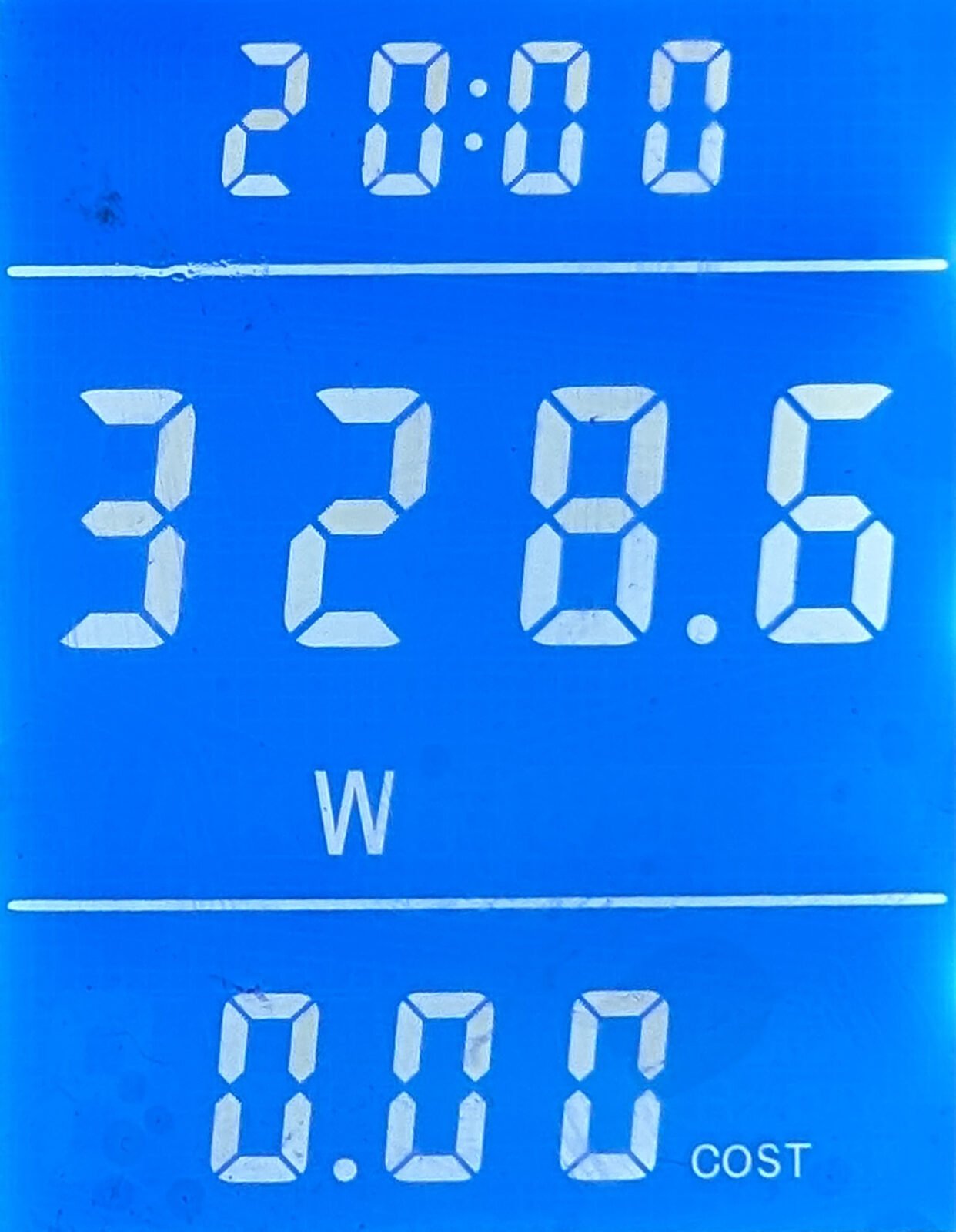
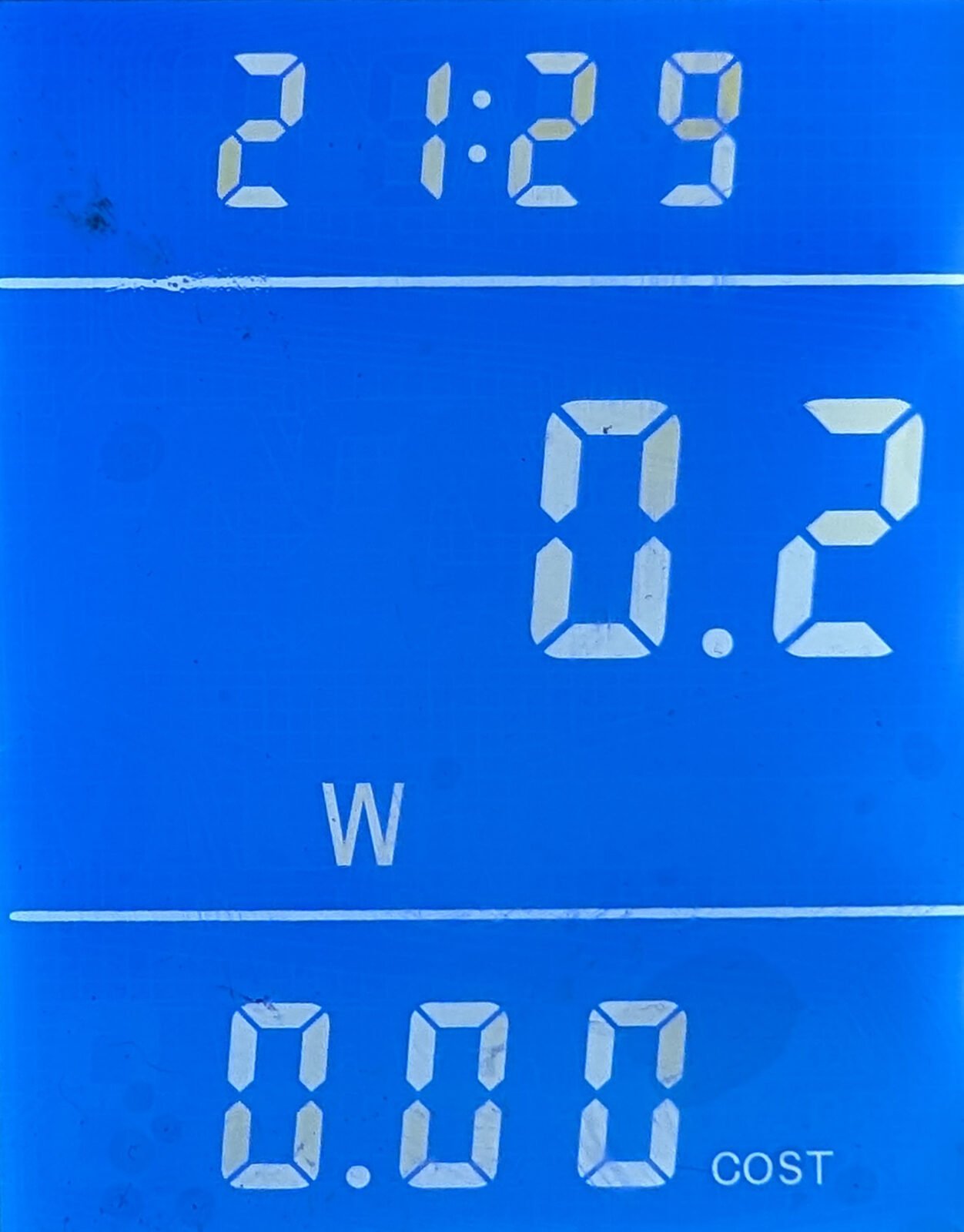
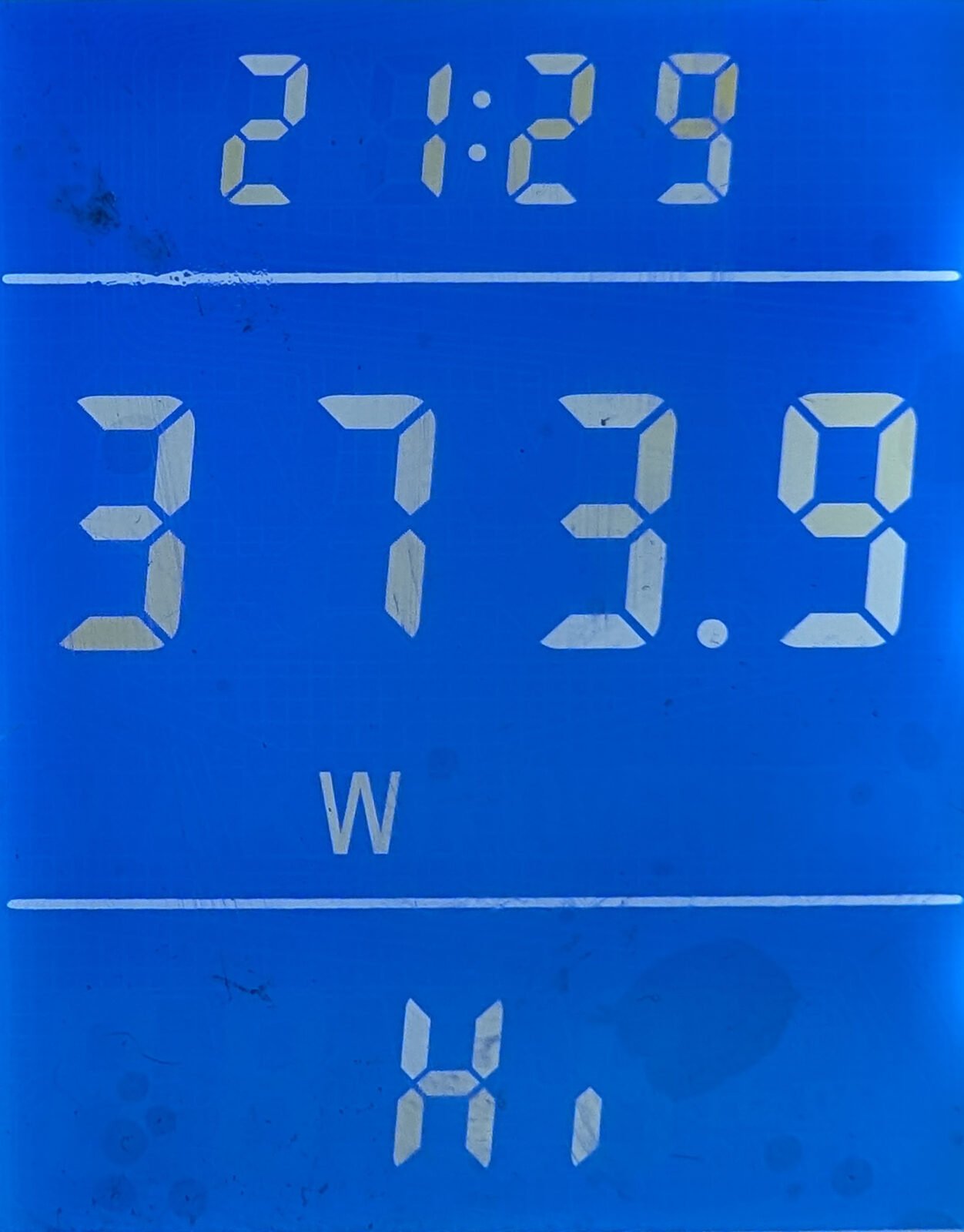
It performed well. The compressor engaged almost immediately, hit 301 watts within about 90 seconds, and climbed to 328 watts by the 20-minute mark, with the meter’s peak-hold catching 373.9 watts somewhere in there. Humidity fell steadily the whole time — 71% down to 56% on the panel, 63% down to 58% on our hygrometer. Exhaust air held at 103-105°F, matching every other mode we confirmed as actively dehumidifying.
No drama. It engaged fast, ran consistently, and pulled water.
One gap worth naming: we never tested Continuous Mode, so we can’t tell you what it draws.
Noise and Heat
Noise: a clean 50 dB at three feet, measured with the garage fans off, while the unit was actively dehumidifying on high fan. Aeocky claims 44 dB on the lowest fan setting, which we didn’t test. But 50 dB with the compressor running and nothing else in the room is genuinely quiet — comparable to a refrigerator hum, not a box fan.
Heat: the exhaust runs warm. We measured 103-105°F coming out against an 86-87°F room, a rise of roughly 17 to 18 degrees. That’s just how compressor dehumidifiers work — the heat the compressor generates goes right back into the air passing through. Run one in a closed room and it’ll warm that room slightly while drying it. If you’re already fighting an air conditioner in summer, that’s worth factoring in.
The Five Modes, Decoded
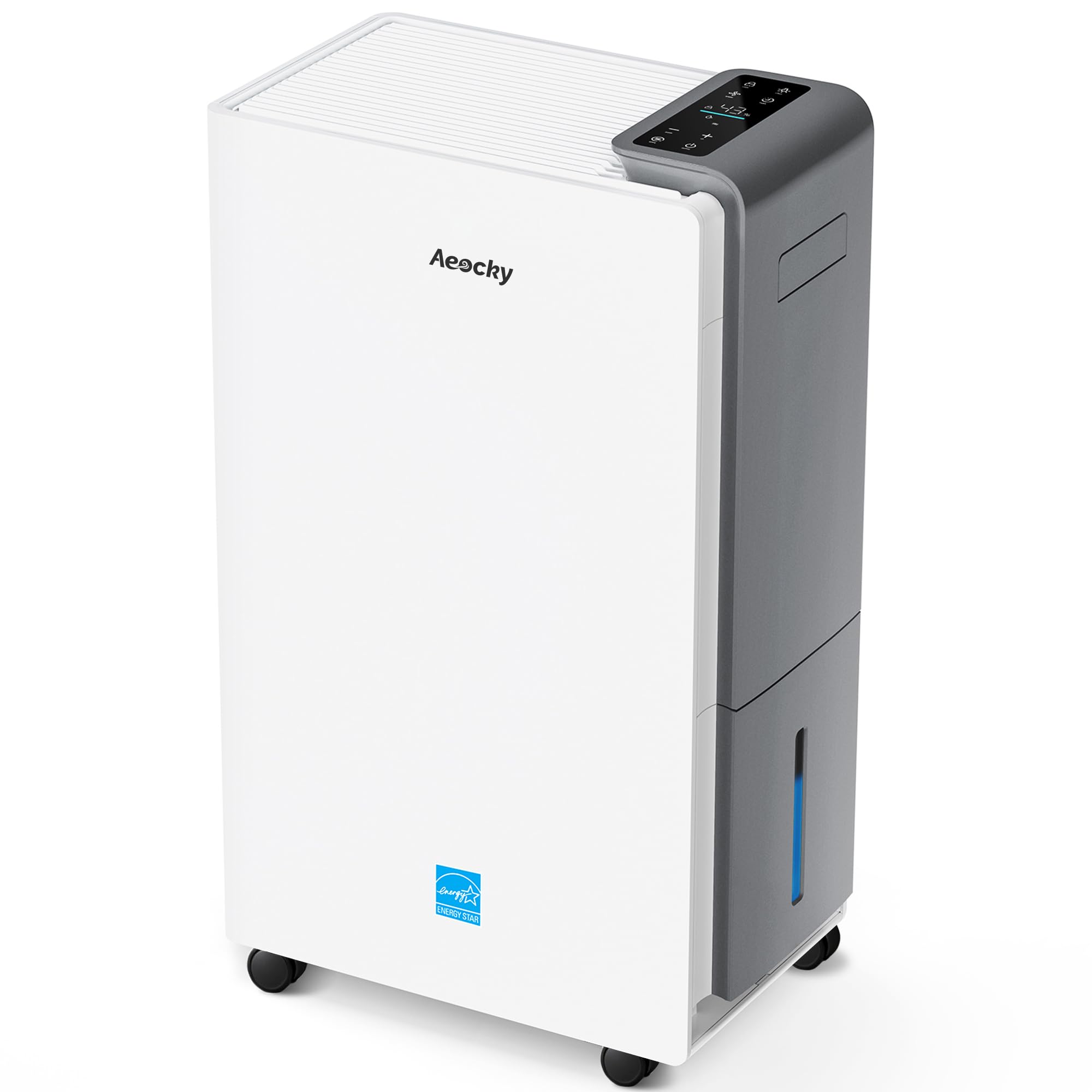
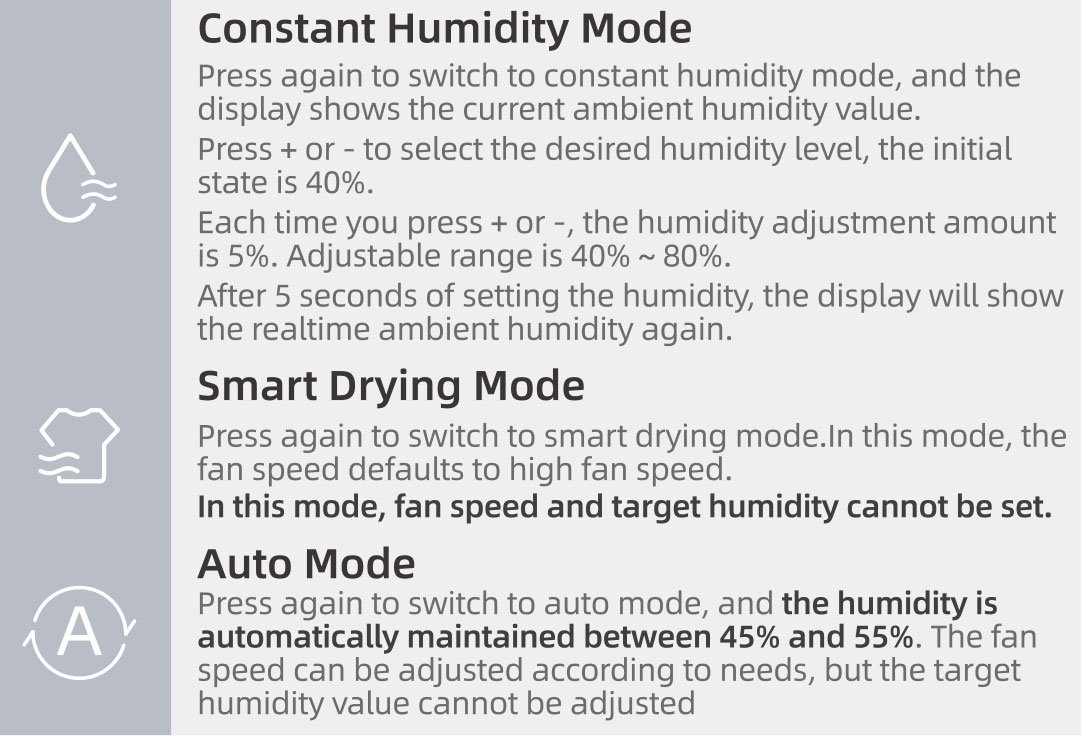
The RHEA-001 runs on what Aeocky calls an Intelligent Humidistat, with five modes. The names don’t always match what they do:
Mode | What It Does | What You Can Change |
|---|---|---|
Auto | Holds humidity between 45-55% | Fan speed only |
Constant Humidity | Runs to a target you pick, 40-80% in 5% steps | Fan speed and target |
Continuous | Runs non-stop, no target | Fan speed only |
Smart Drying | Fixed high fan | Nothing |
Sleep | Low fan, dimmed lights | Nothing |
Here’s the irony: Smart Drying is the least adjustable mode on the machine. Fan speed locked, target humidity locked. And “smart” doesn’t mean connected — there’s no app, no Wi-Fi, no remote anything. The unit’s own ENERGY STAR record spells it out, listing it as “Connected Capable: No.”
That said, it works. Our dedicated test above showed it engaging and running exactly as it should. “Smart” here just means “set it and forget it,” not “check it from your phone.”
One Trade-Off Worth Understanding
In Sleep mode, the full-tank alarm doesn’t sound. Every other mode gives you three beeps and a solid red light when the tank fills. Sleep mode gives you a dim “FL” on the display and nothing else.
This turns out to be deliberate, not an oversight. Aeocky told us it’s a design choice based on customer research — nighttime full-tank alarms were waking people up, so Sleep mode suppresses the audible alert specifically to keep the room quiet. The unit still stops when the tank is full and still shows the indicator. Only the beep is silenced.
That’s a reasonable trade for most people. Just know what you’re trading: run it unattended overnight in Sleep mode and if the tank fills at 2 a.m., the unit stops and nothing audible tells you. Whether that matters comes down to how you use it — a quieter night versus a heads-up that it’s done working. If you drain to a hose instead of the tank, the question is moot.
Before You Plug It In
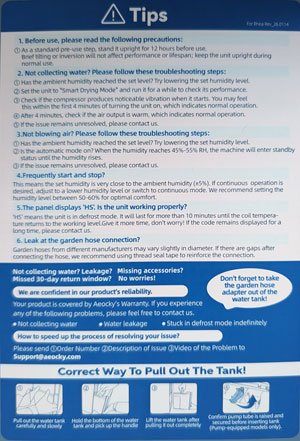 One setup step worth not skipping: let the unit stand upright for a while before you first power it on, especially after shipping. Compressor units can have their refrigerant and oil shift around during transport, and running one before things settle can stress the compressor on startup. Aeocky makes this hard to miss — there’s a large tip sticker right on the side of the unit spelling it out.
Worth noting a small inconsistency in Aeocky’s own guidance here: the sticker on the unit says stand it upright for 12 hours before use, while Aeocky’s media rep told us 24 hours when we asked directly. Either way, the practical advice is the same — give it time to settle before that first run, and if you can spare the longer window, there’s no harm in it.
Drainage, Filter, and the Pump Question
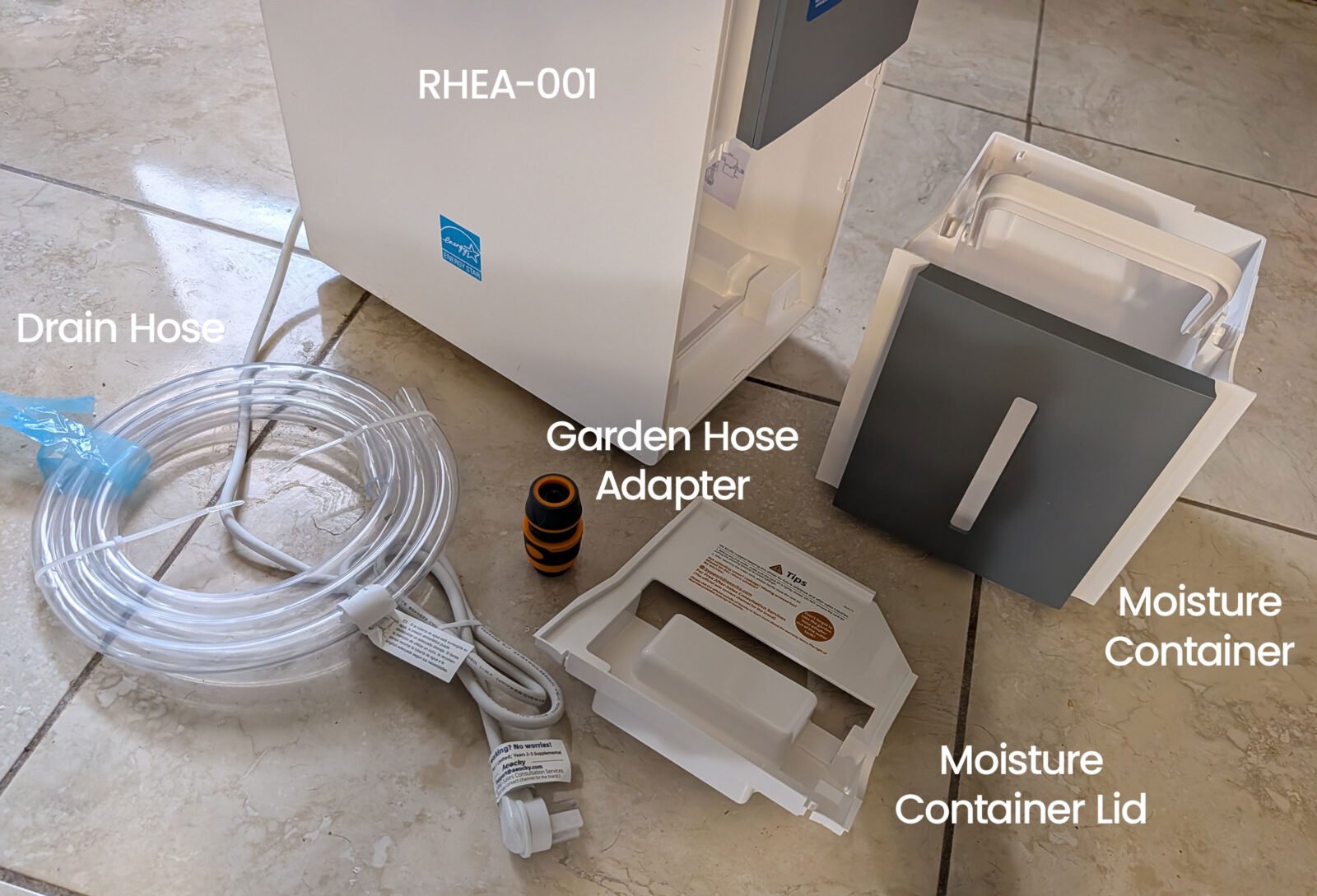
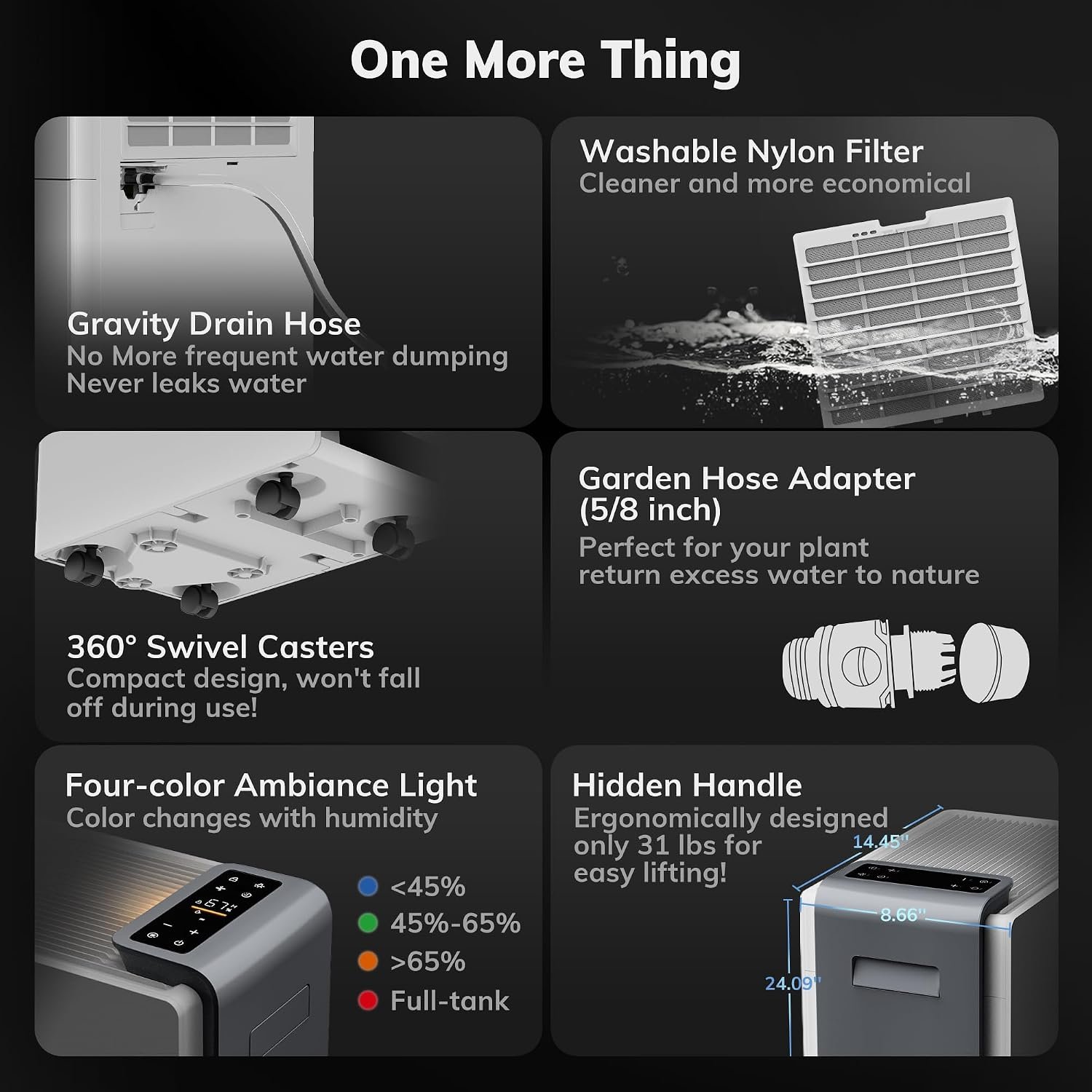
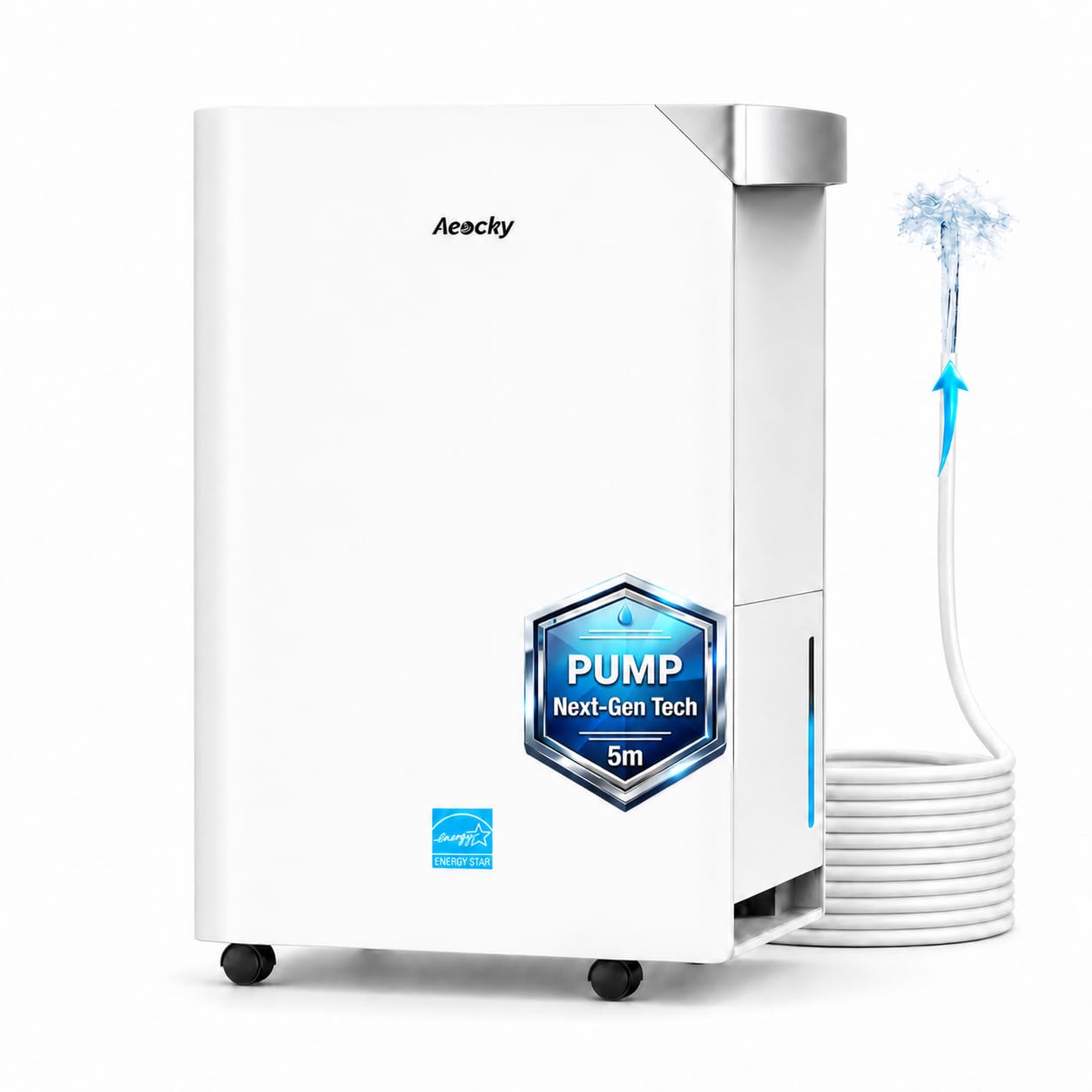
No pump. An old Aeocky press release described the RHEA-001 as having a built-in condensate pump, which never matched the manual. Their current product site settles it: the Rhea Series lists “Continuous Gravity Drain – with Drain Hose,” while a built-in pump is the headline feature of the separate Leo Series. This unit drains by gravity only. If you need water pushed uphill to a sink or out a window, look at the Leo instead.
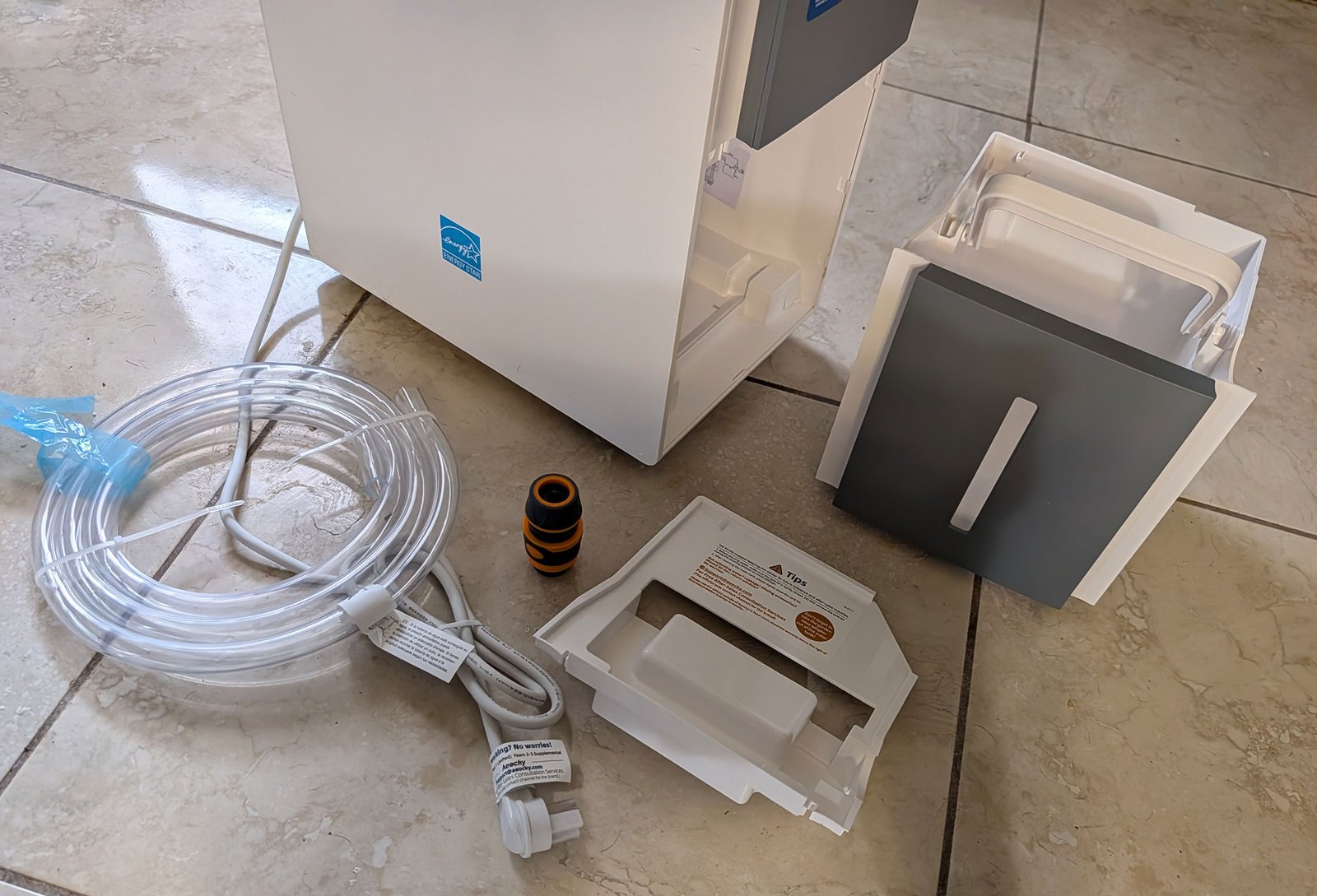
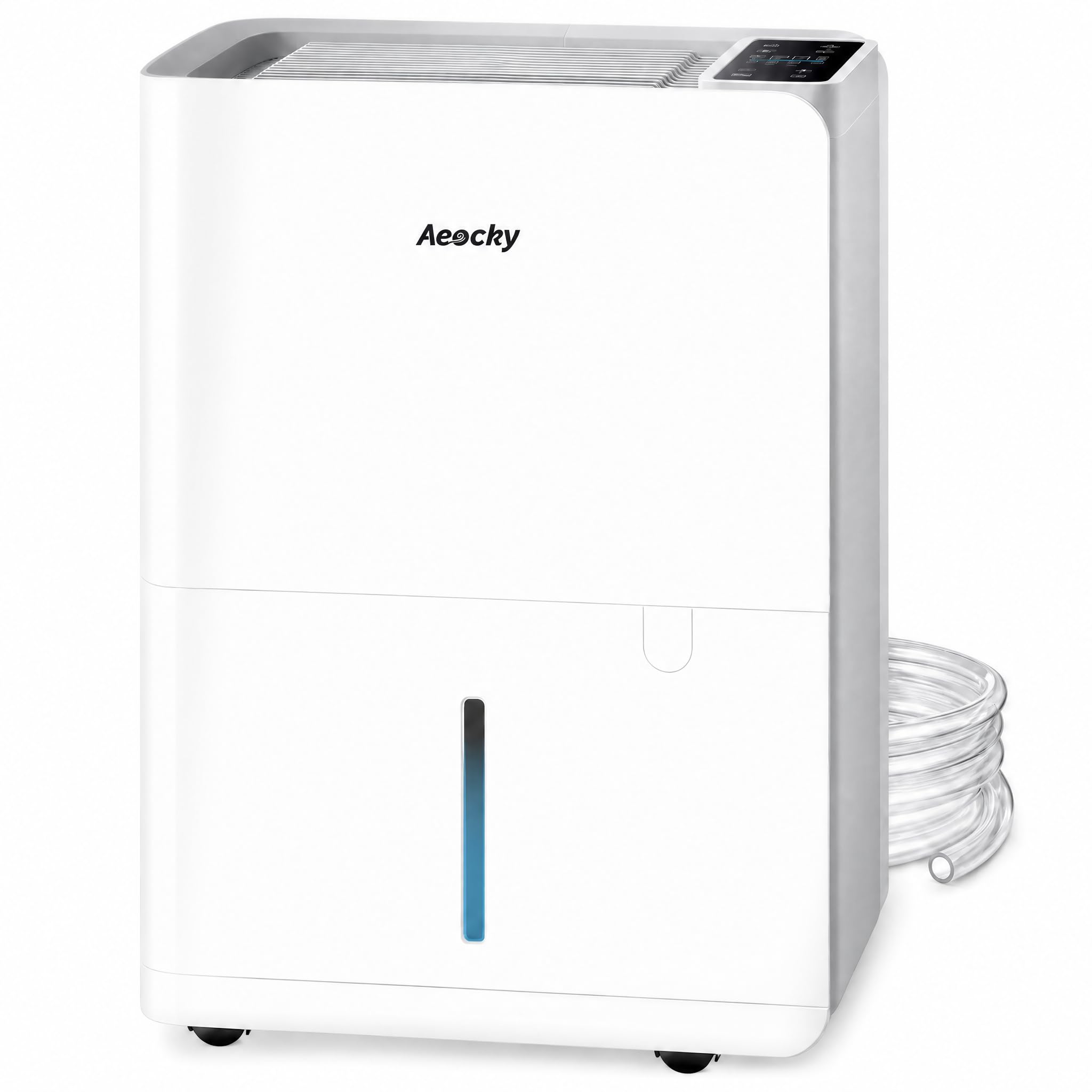
The hose is awkward out of the box. It ships tightly coiled and fights you when you try to feed it into a bucket, and the port has a flap you have to peer under to seat the connection properly. Good news: the manual tells you to trim the hose to length, and since it’s gravity-fed anyway, a shorter, straighter run solves most of the annoyance. Do that first and you’ll skip the wrestling match we had.
The filter is washable and easy. Pull it out, rinse it under the tap, let it dry completely before it goes back in — the manual is emphatic about not reinstalling it wet. Every 2 to 4 weeks. Also wipe down the bottom and edges of the water tank every 1 to 2 weeks, which the manual recommends to keep standing water from growing anything unpleasant.
The Rest of the Hardware
| Feature | Details |
|---|---|
| Washable nylon filter | Mesh, reusable, no cartridges to buy. |
| 5/8″ garden hose adapter | Stored in the tank. Lets you run drainage out to a garden or a floor drain farther away. |
| 360° swivel casters | It rolls and pivots easily, which matters on a 32-pound unit. One buyer noted the wheels are small and struggle on carpet. Fine on hard floors. |
| Four-color ambient light | Not just decoration. Blue means under 45% humidity, green is 45–65%, orange is above 65%, and red means the tank is full. Genuinely useful at a glance from across the room. |
| Hidden handle | Recessed into the top for lifting. |
| Tank window and splash guard | Check the water level without pulling the tank, and the guard helps keep water in the tank while carrying it. One reviewer still managed to overflow it by pouring too fast, so take it slow. |
Specs at a Glance
Spec | Aeocky Says | We Found |
|---|---|---|
5,500 sq. ft. | Confirmed by Aeocky directly; older 4,500 figures are outdated | |
Water removal | 80 pt/day (95°F/95% RH) or 56 pt/day (86°F/80% RH) | ENERGY STAR-certified at 24.5 pt/day; we measured 9.2-36 depending on conditions |
Tank capacity | 1.45 gallons (~11.6 pints) | Matched our measurements exactly |
Wattage | 280 W | 301-337 W sustained, 373.9 W peak (8-33% over, explained above) LINK |
Weight | 31 lb unit / 34.8 lb shipping | Measured 32.5 lb |
Dimensions | 14.45″D x 8.66″W x 24.09″H | Measured 14.5″ x 8.75″ x 24″ |
Warranty | 3 years (1-year base + 2-year supplemental) | Void if bought through an unofficial retailer |
The Thing We Couldn’t Test: Will It Last?
Two days of testing tells you whether a dehumidifier works. It tells you nothing about whether it’ll still work next summer. So we went looking.
Aeocky’s Amazon listing carries 6,577 ratings averaging 4.4 out of 5 — 76% five-star, 7% one-star. Amazon’s own review summary calls it quiet, effective, and good value, then flags durability as a concern, citing multiple buyers whose units failed around the 10-month mark.
Reading individual verified reviews, that window is wider than 10 months. We found detailed accounts of failures anywhere from 8 months to roughly 2 years, and they describe the same thing nearly every time: the evaporator coil ices over, the compressor runs rough or stops kicking on, and the unit quietly stops pulling water. That pattern is consistent with a slow refrigerant leak.
This is not our finding — we didn’t run the unit long enough to see it, and we can’t tell you what share of total units are affected. But it shows up often enough in verified owner reviews that you should know about it before you buy.
Where Aeocky Genuinely Delivers
Here’s the flip side, and it’s a big one.
Almost every review describing a failed unit describes the same aftermath: a fast email reply, a short round of troubleshooting, and a brand-new replacement shipped out — often within days, usually with no requirement to send the broken one back, sometimes with a warranty extension tacked on as an apology. Plenty of those buyers said the support experience alone was enough to keep recommending the brand.
We got a taste of it ourselves. While fact-checking this review, we emailed Aeocky’s media team about the coverage discrepancy, the pump confusion, and a technical question about compressor behavior. They came back fast, answered each question specifically, and corrected their own press material without being pushed.
On the technical question, instead of brushing us off, they asked sharp diagnostic questions and proposed a retest protocol. Their manual and site both promise a response within 24 business hours, and that matched what we got.
So: a company whose marketing oversells in a few places, but whose support actually shows up. In a category full of budget brands that go silent the moment something breaks, that’s worth real money.
Pros and Cons
How It Stacks Up
We looked at three units commonly cross-shopped against this one. Important: everything below for the Waykar, Midea, and DGVAM comes from manufacturer specs, not our testing. Only the Aeocky row reflects numbers we measured ourselves.
Product | Claimed Capacity | Claimed Coverage |
|---|---|---|
Aeocky RHEA-001 | 80 pt/day (95°F/95% RH) | 5,500 sq. ft. |
Waykar 80Pint | 80 pt/day | 5,000 sq. ft. |
Midea Cube | 20 pt/day | 1,500 sq. ft. |
DGVAM V2 | Est. 45-50 pt/day | 4,500 sq. ft. |
The Waykar’s 80-pint claim almost certainly comes from the same saturation-condition test we unpacked above — it deserves the same scrutiny before you take it at face value. The DGVAM’s capacity figure has been flagged elsewhere for a labeling error on the box that its manufacturer hasn’t cleared up. None of these three have been through the kind of testing we put the Aeocky through, so treat their numbers as a research starting point.
Other Aeocky Models
If the RHEA-001 isn’t the right shape for your space, here’s the rest of the lineup. We haven’t tested any of these — descriptions come from Aeocky’s own product naming and positioning.
Last updated on 2026-09-16
Model | Built For | What Makes It Different |
|---|---|---|
Leo | Basement & home | ENERGY STAR Most Efficient, with the built-in pump the Rhea lacks |
Leo-Lite | Home & basement | Lighter-tier model in the Leo family |
Arion | Small and portable, not for large spaces | |
Boreas-001 | Bedroom & humid rooms | The one Aeocky model with independent third-party testing we know of: measured ~5.8 pt/day against a marketed 50-pint claim |
VivaSilent | Bathroom & closet | Positioned as ultra-quiet and compact |
X1-Pro | Cold spaces | Desiccant rather than compressor — less capacity, but works in cold without defrost cycles |
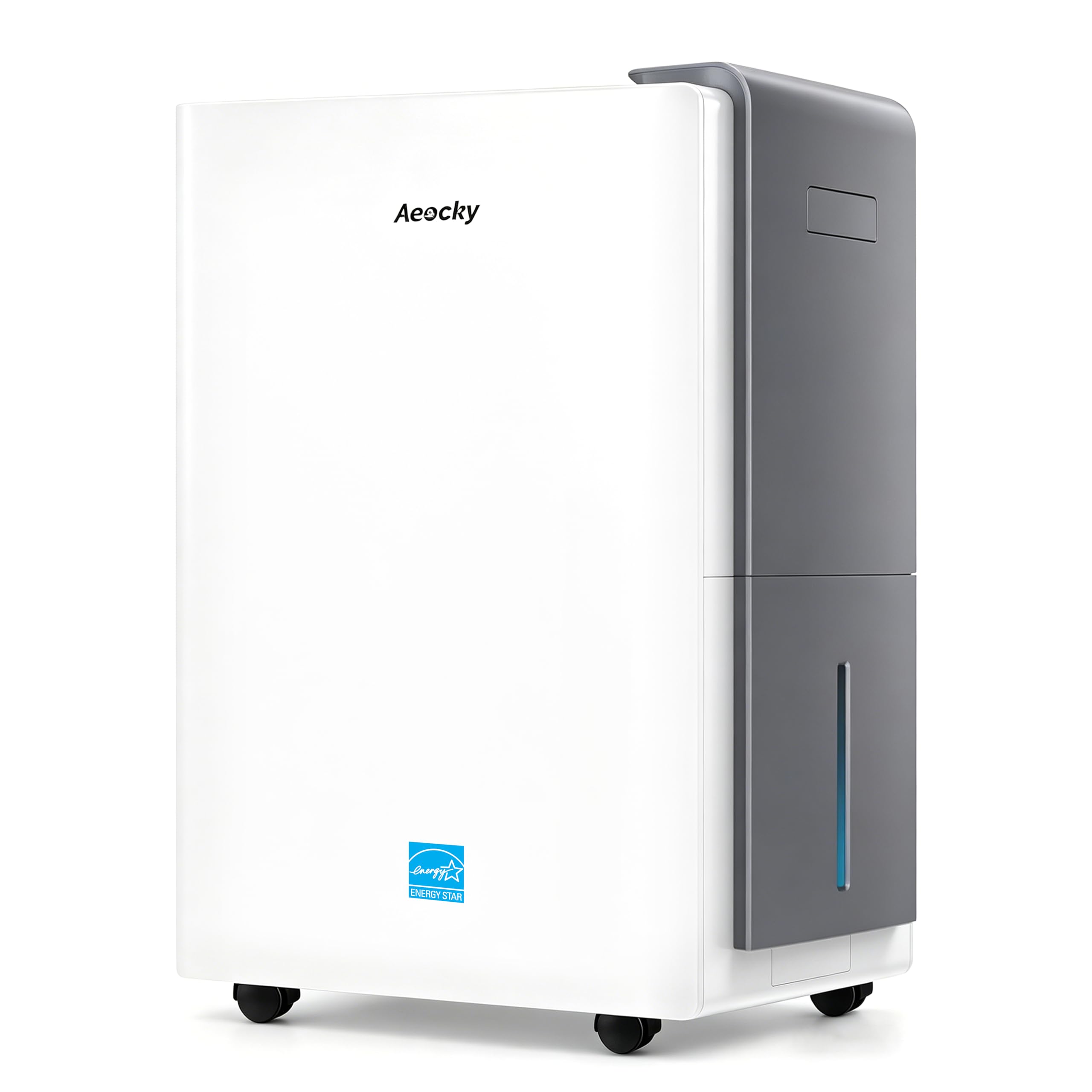
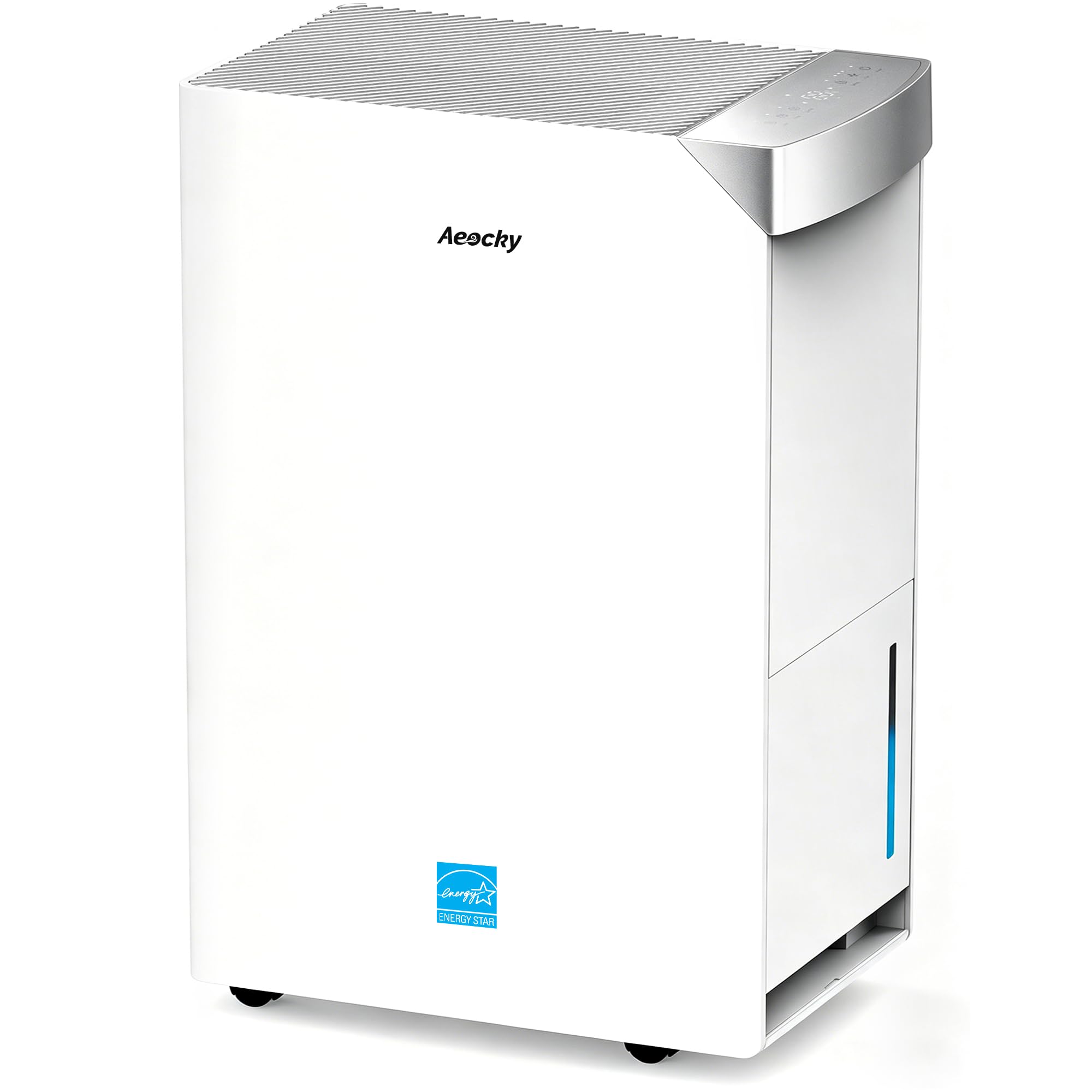
AEOCKY 5500 Sq.Ft Energy Star Most Efficient 2025 Dehumidifier Max 80Pint/D
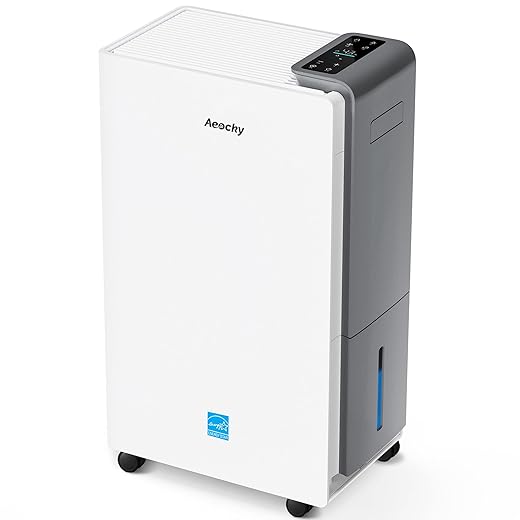
It can remove up to 80 pints of moisture per day in very humid conditions and is designed for homes up to 5,500 square feet.
It uses energy-saving technology, copper coils, and smart humidity sensors that automatically adjust operation.
Defrost sensors help it work in cooler areas such as basements and garages, while the lowest fan setting is rated at 44 dB.
The 31-pound unit includes a three-year warranty and ETL and RoHS certifications.
Actual performance and energy savings depend on the room’s size, temperature, humidity, and how long the unit runs.